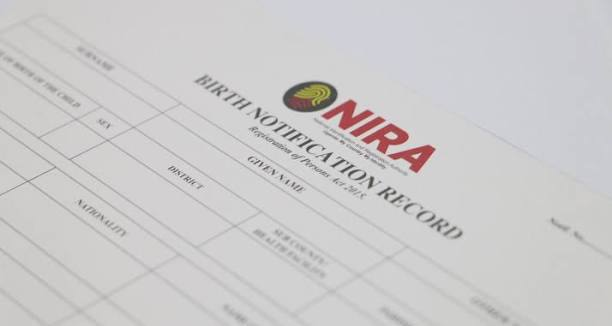
To register a birth and obtain a birth certificate in Uganda, arrange the birth notification, prepare the required identification documents and submit the appropriate application to the National Identification and Registration Authority, or NIRA.
For a hospital birth, begin with the health facility’s notification record. For a home or community birth, seek guidance from the relevant local authority and NIRA office. A birth certificate application generally requires the notification record, a completed NIRA birth form and identification for the parent or notifier.
Birth registration itself is free. The certificate may attract a prescribed fee, depending on the applicable category and timing of registration. NIRA’s updated fee information replaces the older flat UGX 5,000 figure still visible on some pages.
Birth Registration in Uganda: Quick Overview
| Question | What to know |
|---|---|
| Responsible authority | NIRA |
| Where to begin after a health-facility birth | The facility’s birth notification service |
| Where to begin after a community birth | Relevant local authority or NIRA office |
| Main published birth form | Form 3, Notice of Birth of a Child |
| Is birth registration free? | Yes |
| Is the notification record the certificate? | No |
| Can an older child or adult seek registration? | Ask NIRA about late registration and supporting evidence |
| Is there a guaranteed collection date? | Confirm with the receiving office |
Birth Notification, Registration and Certification Explained
Understanding these stages helps you ask for the right service.
Birth notification
Notification records that a birth occurred and supplies the information needed for registration.
A health facility can issue the relevant record for a birth there. Community births follow the appropriate local reporting route.
Birth registration
Registration enters the birth in the official register maintained by NIRA.
Do not assume that receiving hospital discharge papers means every registration step has been completed. Ask whether the birth has been notified and what remains to be done.
Birth certification
A birth certificate is issued from the registered information following the applicable application process.
The notification record supports registration and certification, but it is not the same document as the birth certificate.
| Record | Main purpose |
|---|---|
| Birth notification | Records and reports the occurrence of the birth |
| Registration entry | Establishes the official record of the event |
| Birth certificate | Provides the certificate issued from that registered information |
| Child’s NIN record | Identifies the child’s registration record; it does not replace every required document |
When Should You Notify a Birth?
Begin promptly after the child is born.
The published Births and Deaths Regulations require notification within 30 days of the event. Parents should therefore avoid waiting until a passport application or school requirement makes a certificate urgent.
The six-month threshold in the certificate fee schedule is not a reason to postpone notification. It concerns the fee structure and should not be confused with the notification deadline.
If the birth was not notified in time, contact NIRA for the late-registration procedure. Do not change the date of birth to make an application appear timely.
Who Can Notify or Apply?
A parent is the usual starting point. The published rules also make provision for a guardian, person having charge of the child or another responsible notifier in specified circumstances.
If a parent cannot attend or information is unavailable, explain the circumstances to NIRA. Ask who may make the notification and what supporting evidence is required.
The notifier should understand the declaration being signed. Do not ask someone to certify facts they cannot truthfully explain.
Documents Required for a Birth Certificate in Uganda
Prepare the applicable documents before visiting the receiving office.
| Document or information | Purpose |
|---|---|
| Birth notification record | Supports the details of the birth |
| Completed NIRA birth form | Supplies the required registration or application information |
| Parent’s National ID copy | Supports parental identification for Ugandan applicants |
| Notifier’s identification | Identifies the person making the declaration |
| Relevant NIN information | Helps link existing records where applicable |
| Payment receipt, if a fee applies | Confirms payment for the correct service |
| Other requested supporting records | Addresses missing information or case-specific questions |
NIRA’s published handbook identifies Form 3 and a copy of at least one parent’s National ID for Ugandan applicants. Its booking checklist additionally refers to the notifier’s ID and the applicant’s NIN or ID.
Ask the receiving office how those requirements apply to a newborn, an older child or an adult applicant. Do not assume a newborn must already possess a physical National ID.
Take readable copies and available originals for verification.
read Also: How to Legally Own a Firearm in Uganda | A Step-by-Step Guide
Step-by-Step: Registering a Birth and Applying for a Certificate
Step 1: Confirm the child’s details
Agree on the child’s full names and check the date, sex and place of birth against the available records.
Compare the parents’ names with their identification documents. Resolve an apparent inconsistency before carrying the same mistake into the application.
Keep the actual birthplace distinct from the family’s current residence or place of origin.
Step 2: Obtain the birth notification record
For a birth in a hospital or other medical facility, ask the facility’s responsible records or maternity staff about the notification record.
For a home birth, contact the relevant local authority or NIRA office. NIRA’s published guidance describes the subcounty chief or town clerk as part of the community notification route.
Ask which officer records the event and what evidence is needed. Do not assume an informal letter automatically replaces the prescribed notification.
Step 3: Check whether the birth already has a registration record
If a notification was submitted earlier, ask whether the birth has already been registered.
This matters for older children and adults whose parents may have completed some steps years ago. Starting again without checking can complicate the enquiry.
Keep any earlier reference, certificate copy or notification available.
Step 4: Obtain and complete the appropriate NIRA form
Ask NIRA for the current Form 3 or applicable birth application form.
Complete the child’s details, parental information and notifier’s declaration accurately. Read the instructions before signing.
Leave official-use sections for the responsible officer. If you do not understand a question, request guidance rather than inventing an answer.
Step 5: Confirm the certificate fee
Ask NIRA to determine the applicable category using the registration record and timing.
The published fee amendments tie the certificate bands to when the birth is registered. If the birth was registered earlier but you are requesting a certificate now, explain that distinction before paying.
Confirm the payment instructions for a paid application and retain the receipt.
Step 6: Submit the application and supporting documents
Take the notification, completed form, identification records and any required receipt to the designated receiving office.
Ask whether originals are needed for inspection and whether any document must be certified.
If something is missing, request a clear explanation of what to supply and how to return it.
Step 7: Keep the acknowledgement
Retain the application reference or acknowledgement provided.
Record the submission date and office. Keep private copies of the documents submitted so you can follow up consistently.
Ask where the certificate will be collected and what identification or acknowledgement is needed.
read Also; Top Private Security Companies in Uganda: Leading Providers in 2026
Step 8: Check the certificate on collection
Review the child’s names, birth details and parental information before leaving.
If an entry is wrong, ask about correction immediately. Do not alter the printed certificate yourself.
Store the original safely and keep a secure digital copy for reference.
Birth Certificate Fees in Uganda
NIRA’s updated published schedule lists the following bands for citizens.
| Published category | Certificate fee |
|---|---|
| Birth registered within the first six months | Free |
| Seven months to six years | UGX 10,000 |
| Seven years to 18 years | UGX 20,000 |
| Above 18 years | UGX 50,000 |
The fee amendment summary describes these bands in relation to the timing of birth registration. Ask NIRA to classify applications close to a band boundary and cases registered earlier.
The schedule also lists USD 40 for a foreigner’s birth certificate and a separate USD 20 late-registration entry for foreigners. NIRA should confirm which charges apply in an individual case.
Birth certificates for children of refugees born in Uganda have a published fee exemption. Provide the relevant refugee-status documentation and confirm the applicable process.
Why do some pages still show UGX 5,000?
Older NIRA materials, including a booking checklist, display a flat UGX 5,000 amount for nationals.
The later fee amendments and current fee listing use the age-band structure above. Do not rely on the older figure without checking.
Are bank charges part of the certificate fee?
Keep any bank or payment-channel charges separate from the statutory service amount.
For a free category, ask whether any payment is required at all. Do not pay an unofficial helper merely because they say payment is unavoidable.
How to Register a Home Birth
A child does not need to have been born in hospital for the birth to be recorded.
Explain the date, place and circumstances to the appropriate local authority or NIRA office. Ask what evidence is needed and who may act as notifier.
If a midwife, birth attendant or other responsible person was present, tell the officer. The published rules recognise specified alternative notifiers when parents are absent or unable to give notice.
Do not fabricate a hospital record for a home birth.
Applying for an Older Child or Adult
Contact NIRA if the birth was never registered or if you cannot establish whether an entry exists.
Prepare existing records that may help explain the facts, while recognising that the authority determines the required evidence.
Be clear whether you need:
- Late registration of a previously unregistered birth.
- A first certificate from an existing entry.
- A replacement for a lost certificate.
- Correction of an existing record.
These requests should not automatically be treated as the same service.
What If a Parent Has No National ID?
Explain the missing identification before submitting.
Ask whether the parent’s NIN, another recognised document or further verification can address the problem. The answer depends on the circumstances and the authority’s assessment.
Do not supply another person’s National ID as if it belonged to the parent.
If information about a parent is unknown, deceased or disputed, state that honestly and request the appropriate guidance.
Foreign Nationals and Refugees
NIRA registers births occurring in Uganda, including those involving non-citizen parents.
Its handbook identifies a parent’s passport for foreign applicants and refugee identification or attestation documentation for refugee cases.
Registering a birth and obtaining a birth certificate should not be confused with a separate determination of citizenship. Ask the relevant authority about nationality questions.
Do not assume the citizen fee table applies to every child born in the country.
Can You Apply Online?
Use NIRA’s official website to check the available services and current instructions.
Digital notification, form preparation and certificate issuance are different stages. Do not assume that entering information online means the birth is registered or the certificate is ready to download.
If an online service does not clearly support your case, contact NIRA or the receiving office before submitting personal records elsewhere.
The National ID pre-registration process should not be assumed to serve as a birth certificate application.
How Long Does It Take?
Ask the office receiving your application for its current guidance.
Processing can involve locating an entry, verifying notification information and resolving missing documents. This guide does not promise a fixed collection period.
If you need the certificate for travel or another deadline, start early and ask the receiving organisation which document it requires.
A vaccination card, hospital record or notification should not be assumed to replace a birth certificate for every purpose.
How to Follow Up
Use the reference supplied at submission and the instructions given by the receiving office.
NIRA publishes the toll-free enquiry number 0800 211 700. Explain the applicant’s name, service requested, submission date, office and reference.
Ask whether further information is needed or collection has been confirmed.
Avoid sharing a child’s complete document images or personal identifiers in public comments when seeking help.
Common Mistakes to Avoid
Confusing notification with certification
Keep track of which stage is complete and ask explicitly whether a certificate application has been submitted.
Using an old fee figure
Confirm the current category instead of relying on the historic UGX 5,000 rate.
Submitting inconsistent names
Compare spelling and name order across the form, notification and parental identification.
Waiting until a deadline
Begin promptly, especially where older records need to be located or verified.
Paying without confirming the service
Make sure a payment relates to the correct application and keep the receipt.
Frequently Asked Questions
Is birth registration free in Uganda?
Yes. Registration is free. Certificate fees are a separate matter and include exemptions and age-based categories.
Is a hospital notification a birth certificate?
No. It records and reports the birth; the certificate is a separate NIRA document.
Can an adult obtain a birth certificate?
Ask NIRA whether the birth is already registered and which certification or late-registration process applies.
Must both parents attend?
Do not assume attendance requirements are identical for every case. Confirm who may apply and the identification required.
Can I register without a hospital record?
Home and community births have a notification route. Ask the local authority or NIRA which evidence applies.
What if the certificate has a spelling error?
Request the appropriate correction process. Do not edit the document or start a second registration to bypass the mistake.
What if the child was born outside Uganda?
Contact NIRA or the relevant Ugandan mission. Overseas births require case-specific guidance rather than automatic use of the domestic hospital route.
Final Checklist
Prepare the birth notification, correct form, relevant identification and any required payment receipt.
Confirm whether the birth is already registered, check every name and date, and keep the acknowledgement.
The essential steps are to notify the birth, ensure registration is completed and request the certificate under the correct category.
read Also: Marcella Karekye: A Trailblazer in Ugandan Government Communications