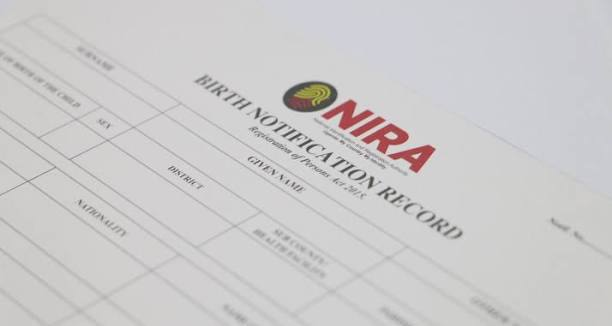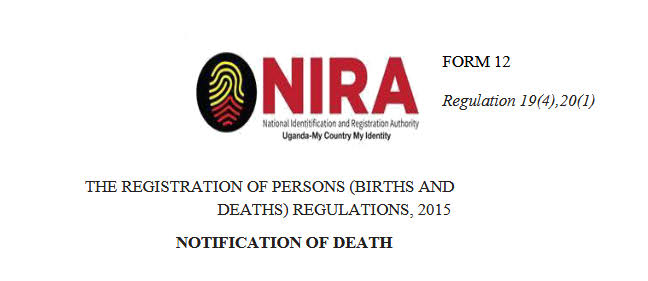
To register a death and obtain a death certificate in Uganda, gather the death notification and relevant supporting records, complete NIRA’s Notification of Death Form 12 and submit the documents to the National Identification and Registration Authority.
The usual checklist includes the notifier’s identification and the deceased person’s National Identification Number, or NIN, where available. Medical evidence, a police report or other supporting documents may be required depending on the circumstances.
Death registration within Uganda is free and compulsory, subject to the applicable law. Certificate charges are a separate matter: the updated published schedule provides free certification for citizens’ deaths registered within the first year and UGX 20,000 where registration occurs after one year.
Families should begin promptly rather than treating the fee threshold as a deadline for notification.
Death Registration in Uganda: Quick Overview
| Question | What to know |
|---|---|
| Responsible authority | NIRA |
| Main notification form | Form 12 |
| Medical cause-of-death form | Form 13 |
| Civil death certificate | Form 14 under the published regulations |
| Who usually starts the process? | Next of kin or an appropriate responsible notifier |
| Is ordinary registration free? | Yes, subject to the law |
| Notification period | Within 14 days under the published regulations |
| Certificate processing time | Confirm with the receiving office |
Death Notification, Registration and Certification Explained
Several documents may be involved after a death. They do not all serve the same purpose.
Death notification
Notification informs the responsible registration officer that a death occurred. It provides the information needed to create or update the official record.
For a death in a medical facility, begin with the facility’s responsible staff. A community death may need local confirmation and additional evidence.
Registration of the death
Registration records the event in the official register maintained by NIRA.
Ask whether a notification has actually reached NIRA and whether the registration is complete. Do not assume funeral arrangements alone complete this process.
Read Also: PepsiCo’s Crown Beverages Launches Evervess Malt Pineapple in Uganda
Death certificate
The civil death certificate is issued from the registered information following the applicable request.
Keep it distinct from a hospital notification, medical certificate or burial-related document.
| Document | Main purpose |
|---|---|
| Death notification record | Reports the occurrence of the death |
| Form 12 | Supplies the formal notification information |
| Medical certificate of cause of death | Provides the relevant medical information |
| Civil death certificate | Certifies the registered death |
| Burial-related document | Serves its specific burial or administrative purpose |
Who Should Notify NIRA of a Death?
The Registration of Persons Act places responsibility first on the next of kin or relative present at the death.
Where that person is unavailable, the law provides for other relatives or responsible persons in a specified order. A guardian, person in charge of the body or another relevant notifier should seek guidance if unsure of their role.
NIRA’s handbook also refers to family meeting minutes witnessed by the LC where responsibility is assigned to the person declaring the death.
Ask which evidence is required in your case. Do not assume that every family member needs to submit a separate notification.
When Must a Death Be Reported?
The published Births and Deaths Regulations require notification within 14 days of occurrence. They also state that registration should happen immediately and, in any case, within three months.
These provisions are separate from the one-year certificate fee threshold.
If notification or registration is late, explain the delay to NIRA. Additional verification or approval may be required.
Do not change the date of death or submit inaccurate information to avoid a late-registration process.
Documents Required for a Death Certificate
Prepare the records that apply to the circumstances.
| Document or information | Purpose |
|---|---|
| Death notification record | Supports the report of the death |
| Completed and signed Form 12 | Provides the formal notification |
| Notifier’s National ID copy | Identifies the person making the declaration |
| Deceased person’s NIN or ID details | Helps identify the correct record |
| Medical cause-of-death record, where applicable | Supports the medical particulars |
| Police report, where applicable | Supports circumstances involving police |
| Relevant family or local confirmation | Establishes the notifier’s role or community circumstances |
| Payment receipt, if a fee applies | Confirms payment for the applicable service |
The receiving office may request further evidence. Carry available originals for inspection and ask whether copies must be certified.
If the deceased person’s card cannot be found, explain that rather than using another person’s identification.
Step-by-Step: Registering a Death and Applying for a Certificate
Step 1: Establish the appropriate notification route
For a hospital death, ask the facility how to obtain the death notification and medical records needed for registration.
For a death outside a facility, contact NIRA for instructions on the supporting evidence and relevant local confirmation.
If police or medical authorities are investigating the circumstances, follow their instructions. Do not invent a medical cause for the form.
Step 2: Gather identification and supporting records
Locate the deceased person’s NIN, National ID or other relevant identification.
Prepare the notifier’s ID and the documents relating to the event. Keep names consistent across the application and available records.
If dates, names or other details differ, raise the discrepancy before submitting.
Step 3: Obtain the correct Form 12
Ask NIRA for the current Notification of Death form or obtain it through its official forms service.
Use the form from the births-and-deaths registration category. Different NIRA services may use similarly numbered forms, so check the title.
Read the instructions and leave sections reserved for officers untouched.
Step 4: Complete the information accurately
Enter the facts supported by the records, including the deceased person’s identity, birth information, date and place of death, and other requested particulars.
Identify the notifier and their relationship or capacity accurately.
If an answer is unknown, ask how it should be recorded. Do not substitute the burial location for the place of death unless the form actually requests it.
Read Also: Everything You Need to Know About Police Bond in Uganda
Step 5: Confirm the fee category
Explain when the death occurred and whether it has already been registered.
The updated certificate fee provisions refer to the timing of registration. If the family is requesting a certificate from an earlier entry, ask NIRA how the record should be classified.
Where payment applies, obtain the official instructions and keep the receipt.
Step 6: Submit the application to NIRA
Present the notification and supporting documents at the designated receiving office.
An LC or local government letter may support the facts, but it does not replace NIRA’s registration role.
Ask whether anything else is required and how to provide it. Record the date of submission.
Step 7: Retain the acknowledgement and collection instructions
Keep the application reference or acknowledgement issued.
Ask where the certificate will be collected, who may collect it and which documents they must bring.
Do not make another application simply because processing takes longer than expected. Follow up on the existing request first.
Step 8: Check the issued certificate
Review the deceased person’s names, date of birth, date and place of death and other visible particulars.
Raise any discrepancy immediately. Do not alter the document yourself.
Store the original securely and keep copies for authorised administrative use.
Death Certificate Fees in Uganda
NIRA’s published fee amendments replace the older flat UGX 5,000 charge for citizens with the following treatment.
| Category | Published certificate fee |
|---|---|
| Citizen’s death registered within the first year | Free |
| Citizen’s death registered after one year | UGX 20,000 |
| Death of a refugee | Free, with relevant status documentation |
| Foreigner’s death certificate | USD 40 |
The current fee list also includes a separate USD 20 late-registration entry for foreigners. Ask NIRA which charges apply rather than assuming every applicant pays both.
Boundary cases and certificate requests following an earlier registration should be checked against the existing record.
Why do older pages still show UGX 5,000?
NIRA’s older booking checklist and handbook still contain that figure. The later fee amendments and current fee listing should guide enquiries.
Do not pay an intermediary based only on an outdated screenshot.
Are other expenses included?
Medical records, document certification, legal assistance or payment-channel services may involve separate costs depending on the circumstances.
Keep those distinct from NIRA’s statutory certificate fee and obtain an explanation before paying.
Registering a Death That Occurred at Home
NIRA’s handbook describes a local authority confirmation letter as supporting evidence where a death occurred at home.
Contact the receiving office for the exact checklist. It may also seek evidence of the notifier’s authority and medical or police records where applicable.
The handbook makes clear that local governments do not replace NIRA as the registration authority.
Do not assume a family statement alone settles every medical or identification question.
What If the Death Was Sudden or Under Investigation?
Follow police and medical instructions before completing uncertain particulars.
Ask which report can be submitted while any investigation or medical examination remains ongoing. Do not assign a cause of death based on rumour or family assumptions.
Keep references supplied by the investigating or medical authorities and explain the position to NIRA.
A civil registration application does not replace a necessary investigation.
read Also:Guide to Land Ownership Systems in Uganda
Registering a Death That Occurred Outside Uganda
NIRA’s published overseas-death checklist differs from the ordinary domestic application.
It lists:
- A copy of the foreign death certificate.
- Completed and signed Form 12.
- The notifier’s National ID or passport copy.
- The deceased person’s NIN, National ID or passport.
- A statutory declaration registered with URSB.
- A covering letter addressed to the Executive Director.
Confirm the current requirements with NIRA or the relevant Ugandan mission. Ask whether translation, authentication or other verification is necessary for the documents you hold.
Do not assume repatriation or burial arrangements automatically update the Ugandan register.
What If the Deceased Had No National ID?
Explain the circumstances to NIRA and provide the identification records available.
Ask how the authority can verify the person’s identity and record the death appropriately. The absence of a physical card should be raised as a documentation issue rather than concealed.
Never use a relative’s NIN as the deceased person’s identifier.
If the person was a foreign national or refugee, state that category and ask for the corresponding checklist.
Can an Old Death Still Be Registered?
Contact NIRA even if the death occurred years ago.
Ask whether an entry already exists before applying for late registration. A family may need a first certificate from an existing record rather than a new registration.
Be ready to explain the delay and provide reliable evidence. The officer should determine which additional approvals or documents apply.
Do not create a second entry to bypass missing paperwork.
What If a Person Is Missing but Not Confirmed Dead?
A missing person should not automatically be registered as deceased.
Presumed death has a separate legal and registration process. NIRA lists a specific application category for it.
Seek case-specific guidance on the required legal determination and documents. An ordinary Form 12 should not be used to declare a death unsupported by the necessary evidence.
Can You Apply Online?
Check NIRA’s official website for the services and instructions currently available.
Downloading a form, booking an appointment and completing registration are different steps. Do not assume submitting a form online means the certificate has been approved.
If an online route is unclear, contact NIRA before uploading sensitive family documents to another website.
How Long Does a Death Certificate Take?
Ask the office receiving the documents for its current guidance.
Processing can involve verifying identity, confirming the notification and locating an earlier registration. Overseas or late-registration cases may need additional checks.
This guide does not promise same-day service or a fixed completion period.
Keep the reference supplied and ask what remains outstanding if the request is delayed.
Why Might a Family Need the Certificate?
Organisations handling a deceased person’s affairs may request official evidence of the death.
Confirm the documents required by the relevant bank, employer, insurer, pension administrator or estate authority.
A death certificate does not, by itself, appoint someone to administer an estate or authorise every withdrawal or transfer. Separate authority may be required.
Avoid distributing unnecessary copies of sensitive records.
read Also: Top Data Centres in Uganda
Frequently Asked Questions
Is death registration compulsory?
Yes. The law provides for compulsory registration of deaths within Uganda.
Is a hospital death notification the civil death certificate?
No. They serve different purposes. Confirm that NIRA registration and the certificate request have been completed.
Do I always need a police report?
NIRA’s handbook lists police reports where applicable. Ask what is required for the circumstances rather than assuming every death needs the same documents.
Can I apply without knowing the cause of death?
Explain the available medical information to NIRA. Do not guess; ask what evidence or clarification is required.
Is a certificate always free?
No. Citizenship or status category and the timing of registration affect the published fee treatment.
Can I register a death after one year?
Ask NIRA for the late-registration process and evidence required. A citizen’s death registered after one year attracts a published certificate fee of UGX 20,000.
What if the certificate contains a mistake?
Request the appropriate correction process and provide supporting evidence. Do not alter the document or submit a duplicate death notification to avoid correction.
Final Checklist
Prepare the death notification, Form 12, identification records and any medical, police or family documentation required.
Confirm the timing of registration and applicable fee. Keep the acknowledgement and check the certificate carefully on collection.
The essential sequence is to notify the death, ensure NIRA records it and obtain the certificate through the correct application category.
Read Also: How to Start or Grow a Business in Uganda in 2026