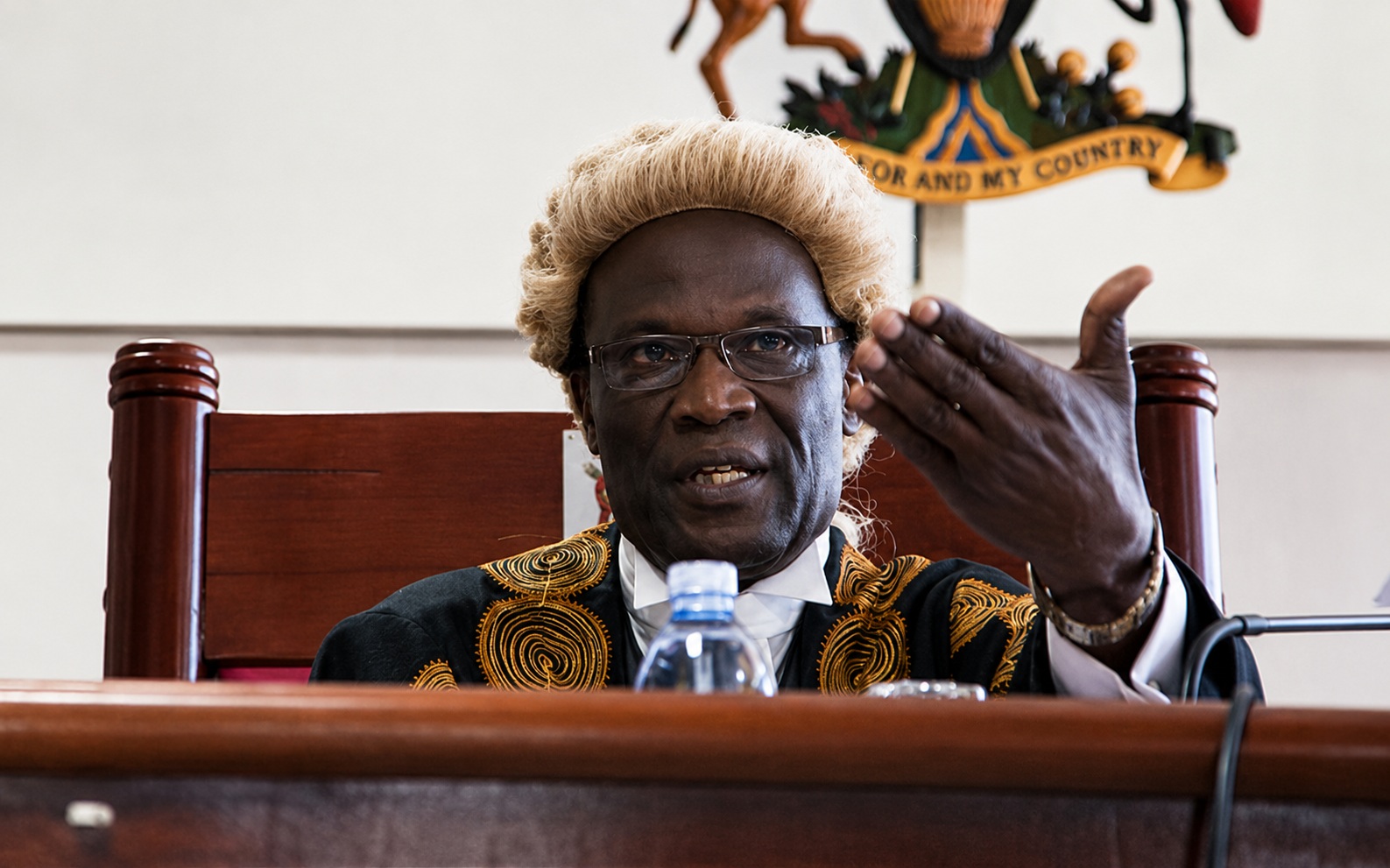
For decades, Justice Steven Kavuma occupied some of the most consequential spaces in Uganda’s public life — from government legal offices and private practice to Cabinet, Parliament and eventually the Constitutional Court.
But his journey to the bench was never merely the story of a lawyer rising through the ranks.
It was also the story of a man whose political past, proximity to the ruling establishment and judicial philosophy would repeatedly place him at the centre of some of Uganda’s fiercest debates about executive authority, judicial independence and the limits of state power.
Long before the black robe, Kavuma had already travelled through the corridors of political power.
A CAREER BUILT ACROSS LAW AND PUBLIC SERVICE
Kavuma entered professional legal practice in 1975, beginning his career as a state attorney in the Attorney General’s chambers, under the Solicitor General’s department.
He was later seconded to the National Insurance Corporation, where he headed the corporation’s legal department before rising to become corporation secretary.
By 1981, however, Kavuma had left government service for private practice.
He established Kavuma & Company Advocates, which later evolved into Kavuma, Katureebe & Company Advocates after he partnered with Bart Katureebe, who would decades later become Uganda’s chief justice.
For many lawyers, such a trajectory might naturally have led toward a conventional career at the Bar and ultimately the bench.
Kavuma took a different road.
THE MOVE INTO POLITICS
Following the National Resistance Movement’s ascent to power in 1986, Kavuma became involved in the Resistance Council structures in Mpigi, serving between 1986 and 1988.
His relationship with the new political establishment would soon become more prominent.
In 1988, President Yoweri Museveni appointed him deputy minister of Finance with responsibility for the Custodian Board.
Kavuma subsequently served as deputy director for legal affairs at the NRM secretariat before entering the Constituent Assembly in 1994 as the representative for Kyadondo South.
His political ascent continued.
He was appointed minister of state for Justice and Constitutional Affairs and later moved to the Defence docket as a junior minister in 1998 — a particularly sensitive period as Uganda deepened its military involvement in the Democratic Republic of Congo.
It was during his time in government that Kavuma became associated with one of the controversies that would follow his public career.
Following a helicopter crash in the Rwenzori Mountains involving Col Jet Mwebaze and others, Kavuma publicly maintained that the men were alive despite reports suggesting they had died.
The government would later confirm Mwebaze’s death.
Critics subsequently cited the episode when questioning Kavuma’s suitability for judicial office. Human-rights lawyer Nicholas Opiyo, for example, later argued that more rigorous scrutiny of Kavuma’s record should have preceded his elevation to the bench.
Yet the controversy did not halt his rise.
FROM NRM POLITICS TO THE CONSTITUTIONAL COURT
In 2004, President Museveni appointed Kavuma to the Constitutional Court.
The appointment marked a dramatic transition: a politician who had openly served the NRM government was now being entrusted with interpreting the Constitution and resolving disputes that could directly involve the same political establishment.
From the beginning, that history ensured his judgments would attract unusual attention.
And it did not take long before Kavuma was confronted with a case testing the boundaries of presidential authority.
THE TUMUKUNDE CASE
The dispute emerged after Brigadier Henry Tumukunde, then an army representative in Parliament, fell out with the government.
Tumukunde challenged attempts by the military leadership and President Museveni, acting as commander-in-chief, to compel him to leave Parliament.
In March 2005, the Constitutional Court rejected Tumukunde’s petition by majority decision.
Kavuma was among the judges who ruled against him.
But it was Kavuma’s interpretation of presidential authority that generated particular controversy within legal circles. His reasoning was widely understood as advancing an exceptionally expansive view of the president’s powers and the extent to which presidential decisions could be subjected to challenge.
Tumukunde appealed.
The Supreme Court subsequently overturned the Constitutional Court decision, concluding that forcing him out of Parliament in the manner complained of was unconstitutional.
The reversal would become an early indication of the constitutional battles that would define Kavuma’s judicial career.
But an even greater test was approaching.
WHEN SOLDIERS ENTERED THE HIGH COURT
Uganda was moving toward the 2006 general election, and political tensions between President Museveni’s government and opposition leader Dr Kizza Besigye were intensifying.
Besigye, preparing to challenge Museveni for the presidency again, was arrested on November 15, 2005.
He faced several serious criminal accusations, including treason and rape.
Then came an event that would become one of the defining moments in Uganda’s modern judicial history.
On November 16, armed security personnel associated with the Anti-Terrorism Task Force — popularly referred to as the Black Mamba — surrounded the High Court in Kampala.
Besigye and several other suspects had been granted bail.
Instead of simply walking free, the suspects found themselves confronted by heavily armed security officers.
The spectacle sent shockwaves across the legal fraternity.
For many judges and lawyers, what occurred was no ordinary security operation. It represented an unprecedented intrusion by armed forces into the physical and constitutional space of the judiciary.
Justice Edmund Sempa Lugayizi, who had been handling aspects of the case, withdrew.
Then-principal judge Justice James Ogoola would famously characterise the episode as an assault on the very temple of justice.
The Uganda Law Society responded by going to the Constitutional Court.
Its legal team included some of the country’s most prominent advocates, among them Godfrey Lule, Peter Mulira, David Mpanga and Medard Lubega Sseggona.
At stake was a question far larger than the fate of individual suspects.
Could security agencies enter court premises and conduct an armed operation without undermining the independence of the judiciary?
FIVE JUDGES. TWO VERY DIFFERENT VISIONS OF STATE POWER
The constitutional petition was heard by a five-member panel chaired by Deputy Chief Justice Leticia Mukasa-Kikonyongo.
Also sitting were Justices Galdino Okello, George Engwau, Constance Byamugisha and Steven Kavuma.
Four members of the panel reached broadly the same conclusion.
The deployment at the High Court had crossed a constitutional line.
They reasoned that the presence and conduct of armed security personnel had endangered the independence of the judiciary and created a continuing threat to the impartial administration of justice.
Kavuma disagreed.
His dissent would become one of the most debated judgments associated with his judicial career.
Rather than viewing the deployment primarily as an intrusion into judicial independence, Kavuma approached the matter through the lens of national security and executive responsibility.
In his reasoning, security authorities were entitled to act on intelligence that suggested intervention was necessary to prevent suspects from escaping justice.
He also rejected the argument that court officials necessarily had to be informed in advance.
Sensitive security operations, he reasoned, frequently depended upon confidential intelligence and operational secrecy.
From Kavuma’s perspective, requiring advance disclosure to judicial authorities could, under certain circumstances, frustrate the security objective itself.
It was a sharply different constitutional philosophy from that adopted by the majority.
Where the four other judges emphasised protecting the judiciary from armed executive interference, Kavuma placed substantial weight on the government’s responsibility to maintain national security.
And at the centre of his reasoning stood the presidency.
THE PRESIDENT AND THE POWER OF THE EXECUTIVE
Kavuma linked the deployment directly to the executive authority established under Article 99 of Uganda’s Constitution.
His position was essentially that decisions concerning the deployment of the Uganda People’s Defence Forces in circumstances involving national security fell within the constitutional sphere of the executive, headed by the president.
The judgment crystallised a question that would continue to shadow his years on the bench:
Where should the courts draw the line when presidential authority, national security and constitutional rights collide?
To supporters of a strong executive, Kavuma’s reasoning reflected the realities of governing a country facing serious security threats.
To critics, it demonstrated an interpretation of the Constitution that gave excessive deference to the executive — particularly troubling given his long political history within the NRM government.
That tension would become inseparable from his public image.
A JUDGE WHO COULD NEVER ESCAPE HIS POLITICAL PAST
Kavuma’s rise was extraordinary.
He had moved from the Attorney General’s chambers to corporate legal leadership, from private practice into revolutionary-era politics, from Parliament and Cabinet to one of the highest courts in the country.
Yet every stage of that journey also shaped the way his judicial decisions were interpreted.
His defenders could point to decades of legal, administrative and governmental experience.
His critics saw something different: a former NRM politician adjudicating disputes in which the power and conduct of the NRM government were often directly at stake.
The Black Mamba judgment amplified those concerns because Kavuma stood alone against four colleagues on one of the most symbolically important questions facing the judiciary at the time.
His dissent was therefore more than a disagreement among judges.
It became part of a wider national argument about what Uganda’s constitutional order was supposed to protect — and how far the executive could go in the name of security.
For Kavuma, the answer consistently appeared to favour a broad understanding of presidential and executive authority.
For his critics, that philosophy raised uncomfortable questions about the distance between political power and judicial independence.
And so the making of Justice Steven Kavuma was never simply about how a lawyer became a judge.
It was about how decades spent inside Uganda’s political and legal establishment produced one of the country’s most consequential — and controversial — judicial figures.
Would you like to get published on this Website? You can now email Uganda Times: an Opinion, any breaking news, Exposes, story ideas, human interest, articles or any interesting videos on: [email protected].