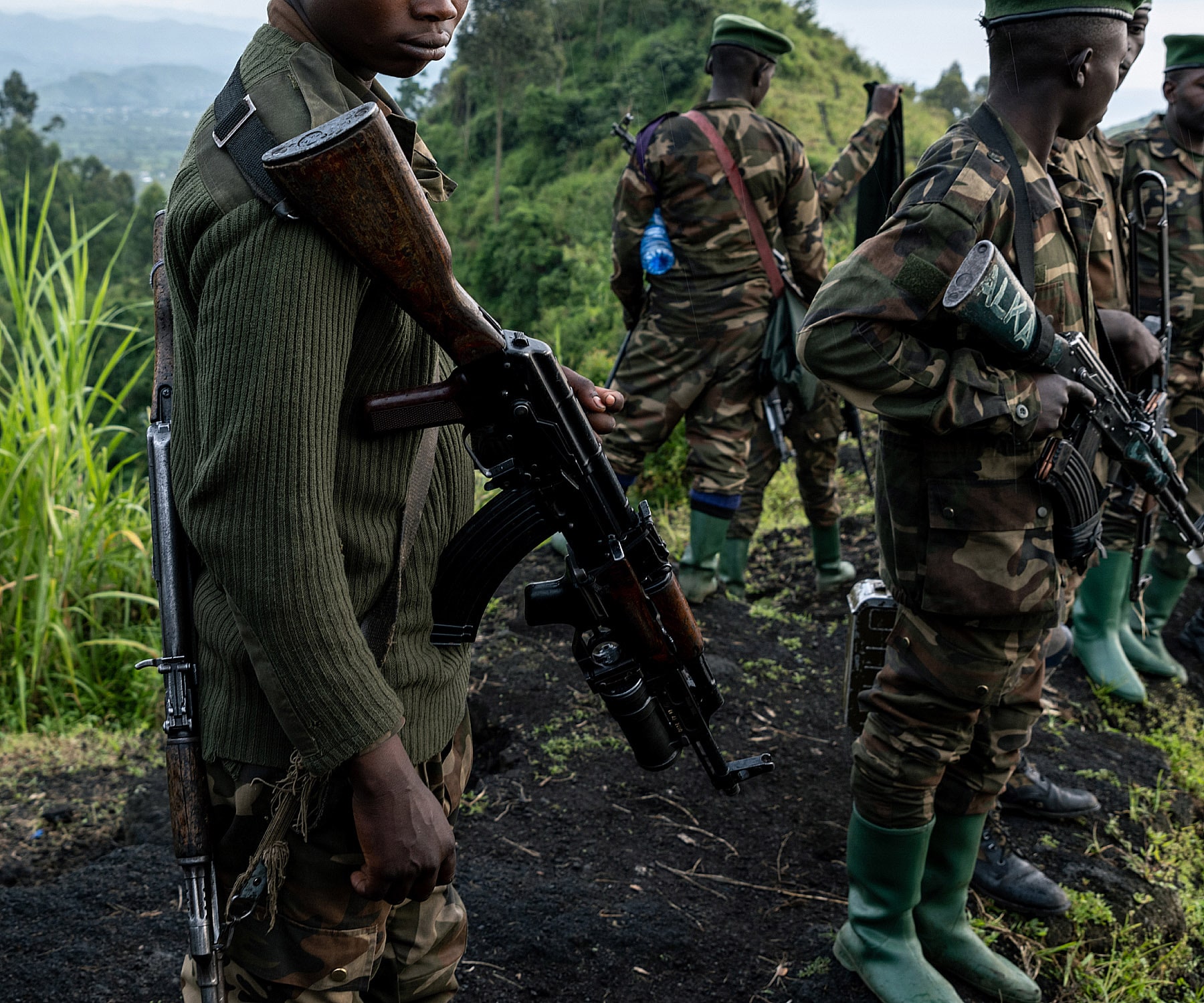
Eastern Congo fighting has intensified again, with the Democratic Republic of Congo’s army and the AFC/M23 rebel movement accusing each other of launching fresh attacks despite commitments intended to reduce hostilities.
The latest clashes have been reported across several parts of North Kivu, particularly along the volatile Masisi-Walikale axis, as well as around Minembwe and neighbouring areas of South Kivu.
On September 20, the Armed Forces of the Democratic Republic of Congo, known as FARDC, said AFC/M23 fighters were carrying out attacks on several fronts between Masisi and Walikale. The army said it continued to observe the ceasefire while reserving the right to defend its positions and civilians.
AFC/M23 has offered the opposite account. Its spokesperson, Lawrence Kanyuka, has repeatedly accused forces aligned with Kinshasa of attacking areas held by the movement, including locations in Masisi and around Minembwe.
The competing claims underline how difficult it remains to establish what is happening across remote and rapidly changing front lines, even as regional and international efforts continue to push both sides towards a more durable peace.
Eastern Congo Fighting Returns to Masisi
One of the latest clashes was reported around Ngululu in Masisi territory on September 21.
Local sources cited by ACTUALITE.CD said fighting began early in the morning after AFC/M23 fighters attacked Congolese army positions near Ngululu. According to those sources, FARDC troops and allied Wazalendo fighters repelled the attack.
Heavy and light weapons could be heard in the area as the confrontation continued.
That account broadly supports the Congolese army’s claim that AFC/M23 has been pressing government positions along the Masisi-Walikale front.
But the rebel movement disputes the broader narrative that it is responsible for restarting hostilities.
In statements issued in the days before the latest FARDC communiqué, Kanyuka accused government-aligned forces of attacking positions in parts of Masisi, including Katoyi and Kasovu, while also alleging offensives in South Kivu. Those claims have not been independently established.
FARDC Accuses M23 of Breaking the Ceasefire
FARDC’s September 20 statement accused AFC/M23 of violating commitments made through the diplomatic processes involving Doha and Washington.
The army said attacks were being carried out on several fronts along the Walikale-Masisi corridor and claimed the fighting had caused new civilian displacement.
It also alleged that villages and crops had been destroyed in affected areas. The military statement did not provide a detailed independent assessment of the scale of the damage or casualties associated with those allegations.
North Kivu military authorities said FARDC remained committed to the ceasefire but would respond to attacks on government positions or civilians.
The language reflects a recurring feature of the conflict: both parties describe their own military operations as defensive while accusing the other side of violating peace commitments.
M23 Accuses Government Forces of Offensive Operations
AFC/M23 has made similar allegations against FARDC and its allies.
Kanyuka said on September 18 that government-aligned forces had launched attacks in areas including Nyaruhinga, Mukoko, Nyamabuguma, Point Zéro and Gipimo in South Kivu.
He also alleged that attacks were taking place around Kasovu and Katoyi in Masisi.
AFC/M23 described its own operations as defensive and accused FARDC, Wazalendo fighters and other armed elements of participating in the offensives.
Independent conflict monitoring also recorded repeated allegations from both government-aligned and M23-aligned sources during September.
Critical Threats Project reported that M23 representatives accused pro-government forces of attacks at several locations in Masisi between September 15 and 18, while government-aligned sources reported advances against M23 positions during the same period.
Those competing reports illustrate the difficulty of confirming battlefield claims in real time.
Control of Villages Continues to Shift
The situation on the ground is particularly fluid in Masisi and Walikale.
During September, several villages and strategic hilltops changed control as FARDC, Wazalendo fighters and AFC/M23 launched attacks and counterattacks.
ACTUALITE.CD reported on September 18 that fighting had continued across several areas of the two territories, with positions repeatedly changing hands.
Government forces and Wazalendo fighters regained the strategic position of Mindjendje in Walikale on September 15 after clashes with AFC/M23, according to local sources.
The rebel fighters reportedly withdrew toward Malemo following the confrontation.
Elsewhere, the picture has been less stable.
Kibati, for example, briefly came under the control of government-aligned fighters before AFC/M23 regained the locality after FARDC and Wazalendo forces withdrew to previous positions.
The repeated movement of front lines has made it difficult for civilians to know when it is safe to return home.
Eastern Congo Fighting Displaces More Civilians
For communities caught between the opposing forces, the arguments over who started individual battles offer little relief.
Radio Okapi reported in early September that renewed clashes in Masisi and Walikale had triggered another wave of displacement, with residents fleeing several villages as fighting expanded.
By September 10, local civil society representatives said at least 16 villages in parts of Masisi had been emptied of their residents following weeks of fighting between AFC/M23 and Wazalendo forces.
Transport and education have also been disrupted.
Fighting along the Kashebere-Mungazi route temporarily stopped traffic, leaving travellers stranded. When conditions improved enough for movement to resume, local authorities said at least 12 schools in the Luberike area remained closed because of insecurity.
That disruption shows why even relatively localized clashes can have consequences far beyond the battlefield.
Road closures affect food supplies and trade, while displacement puts additional pressure on communities already hosting people forced from their homes by earlier rounds of fighting.
Fragile Ceasefire Faces Another Test
The renewed Eastern Congo fighting comes despite diplomatic efforts designed to establish mechanisms for monitoring the ceasefire.
The DRC government and AFC/M23 agreed on a ceasefire framework through negotiations in Doha, with detailed terms for a verification mechanism later adopted in February 2026.
The mechanism is intended to investigate alleged violations and provide a more structured way of determining responsibility when fighting breaks out.
In September, the International Conference on the Great Lakes Region said monitoring teams had carried out field missions in both Minembwe and Masisi.
The organisation described the deployments as an important step towards building confidence between the parties.
However, the fact that heavy fighting continues demonstrates the limits of diplomatic agreements when implementation remains incomplete.
Both sides continue to accuse the other of violating commitments while simultaneously insisting that they remain committed to peace.
Rwanda Remains Part of the Wider Dispute
The eastern Congo conflict also remains closely tied to tensions between the DRC and Rwanda.
Congolese authorities, the United Nations and other international actors have accused Rwanda of supporting M23.
Rwanda has rejected accusations that it is responsible for the conflict and has raised its own security concerns involving armed groups operating in eastern Congo, including the Democratic Forces for the Liberation of Rwanda, or FDLR.
These competing regional security claims have complicated attempts to resolve the conflict.
The DRC government commonly refers to AFC/M23 together with the Rwanda Defence Force in its official statements, while M23 regularly accuses Kinshasa of working alongside the FDLR.
Because these are contested claims between parties to the conflict, they remain an important part of the diplomatic dispute rather than independently established explanations for every clash.
Peace Monitoring Expands as Battles Continue
The timing of the latest fighting is particularly significant because ceasefire monitoring is only beginning to take a more visible role on the ground.
A monitoring mission visited Minembwe on August 24 and 25, followed by another deployment in Masisi from September 10 to 12.
The missions form part of the Expanded Joint Verification Mechanism Plus, which is linked to the Doha process.
MONUSCO is also authorised to provide logistical and technical assistance for implementing the permanent ceasefire and its agreed monitoring arrangements.
In principle, such monitoring should make it easier to investigate competing allegations.
In practice, the geography of eastern Congo, the number of armed actors involved and the speed with which front lines change make verification difficult.
No Clear End to Eastern Congo Fighting
For now, neither FARDC nor AFC/M23 appears willing to accept responsibility for the latest escalation.
Kinshasa says its troops are observing the ceasefire and responding to M23 attacks.
AFC/M23 says it is defending its positions against offensives launched by government-aligned forces.
Local reporting confirms that fighting is occurring, but responsibility for individual incidents often remains disputed.
What is less contested is the effect on communities.
Villages have been emptied, roads repeatedly closed, schools disrupted and families forced to move as the front line shifts between Masisi and Walikale and fighting continues elsewhere in the Kivus.
The latest Eastern Congo fighting therefore presents another test for the Doha ceasefire framework and the international effort to turn battlefield commitments into something that civilians can actually feel on the ground.
As long as the parties continue to trade accusations while launching or responding to military operations, the challenge will be moving from agreements on paper to a ceasefire that holds across the villages and towns of eastern Congo.