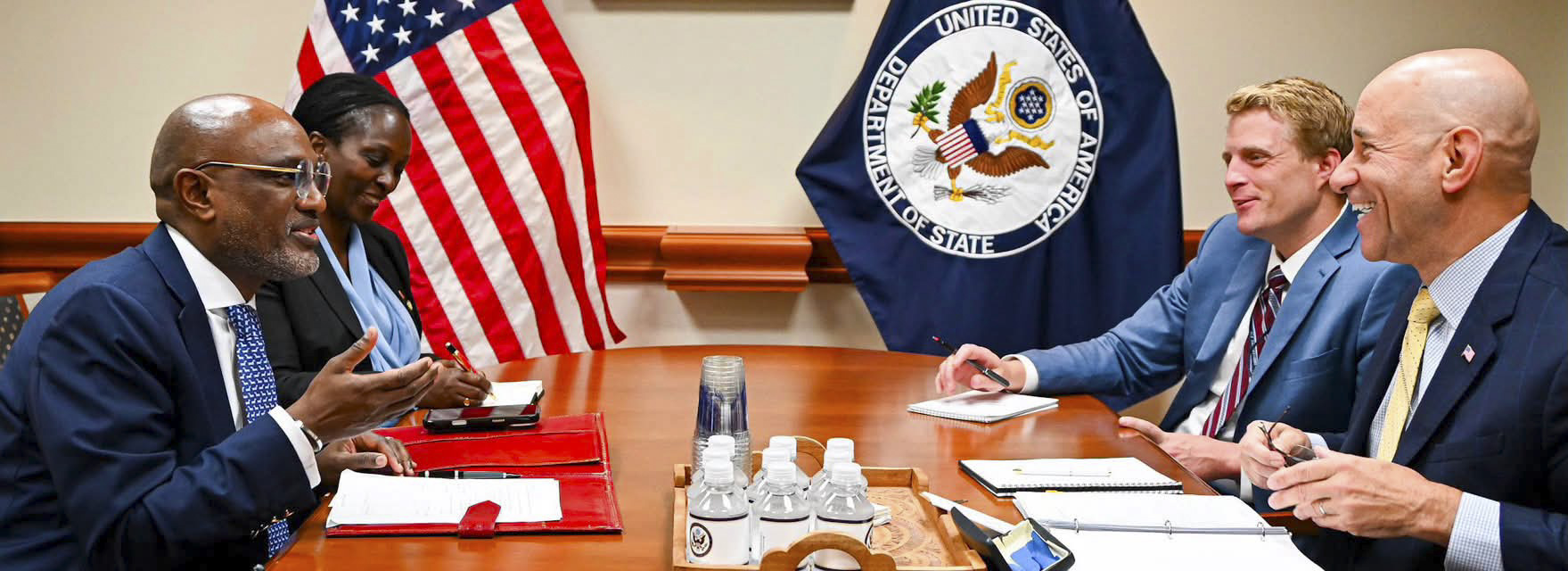
The U.S.-Uganda partnership took centre stage as American officials marked the United States’ 250th anniversary by highlighting expanding cooperation with Uganda in health, trade, investment, technology and regional security.
Speaking in Kampala during events linked to America’s semiquincentennial celebrations, U.S. Chargé d’Affaires Mikael Cleverley said Washington sees significant room to deepen its relationship with Uganda.
The United States marked 250 years since the signing of the Declaration of Independence on July 4, 2026, with commemorative programmes continuing throughout the year.
In Uganda, the milestone has also provided an opportunity for officials to look beyond the anniversary itself and focus on how bilateral relations are evolving.
Recent agreements involving healthcare, aviation and digital connectivity point to a relationship that is increasingly focused on investment and long-term economic cooperation alongside traditional development assistance.
U.S.-Uganda partnership expands beyond traditional aid
For decades, much of the U.S.-Uganda relationship has been associated with health programmes, humanitarian support and security cooperation.
That remains important, but both governments are increasingly talking about trade and investment as another major pillar.
Cleverley said the United States wants to attract more American businesses into Uganda, particularly in sectors that align with the Ugandan government’s development priorities.
These include agriculture, tourism, minerals, science and technology.
He said the embassy is working to help U.S. companies understand Uganda’s market while reducing some of the risks businesses face when investing in a new country.
The shift reflects a broader effort to build commercial relationships that can continue beyond individual aid programmes.
For Uganda, increased American investment could bring capital, technology, jobs and access to international markets.
For U.S. companies, Uganda represents a growing East African market with opportunities in infrastructure, agriculture, aviation, tourism and digital services.
Health remains a major pillar of the U.S.-Uganda partnership
Health cooperation remains one of the biggest components of relations between Washington and Kampala.
Uganda and the United States signed a five-year health cooperation framework covering the period from 2026 to 2030.
Under the arrangement, the United States intends to provide approximately $1.7 billion in support.
Uganda has also committed to increasing its own health spending as part of a gradual move towards greater domestic responsibility for health programmes.
The broader health framework is valued at roughly $2.3 billion when Uganda’s additional domestic commitments are included.
The partnership covers areas including HIV/AIDS, tuberculosis, malaria, outbreak response and health-system strengthening.
It also places greater emphasis on government leadership and accountability.
New health agreement changes how funding is managed
The latest U.S.-Uganda partnership is not simply about the amount of money involved.
It also changes how some health cooperation will be managed.
On September 8, 2026, Uganda and the United States signed a Strategic Objective Agreement setting out how their health commitments will be implemented between 2026 and 2030.
Ugandan officials have said the new arrangement is expected to gradually channel more support through national systems.
That approach is intended to strengthen Uganda’s ownership of health programmes while improving coordination between government agencies and international partners.
A Joint Health Steering Committee is also expected to provide oversight of activities, implementing partners and performance under the agreement.
The success of the programme will therefore depend not only on funding but also on how effectively the money translates into better healthcare services.
Uganda Airlines and Boeing add a commercial dimension
Aviation has emerged as another visible example of growing U.S.-Uganda commercial ties.
On June 10, Uganda Airlines signed an agreement with Boeing for 10 aircraft.
The deal includes four Boeing 787-9 Dreamliners, four Boeing 737 MAX 8 passenger aircraft and two freighters.
Ugandan government sources valued the agreement at approximately Shs3.7 trillion.
The acquisition is intended to expand Uganda Airlines’ passenger and cargo capacity while giving the carrier greater ability to connect Uganda directly with international markets.
The commercial significance goes beyond aviation.
Better air links can support tourism, trade and exports, particularly for sectors that depend on fast access to overseas markets.
Agricultural exporters, for example, can benefit from stronger cargo connections when transporting time-sensitive products.
Boeing deal could support Uganda’s aviation ambitions
Uganda has been trying to position Entebbe as a stronger regional aviation hub.
Expanding Uganda Airlines’ fleet is part of that strategy.
The Boeing agreement is expected to provide the airline with additional long-haul and mid-range capacity while also strengthening its cargo operations.
Government officials have linked the expansion to wider plans to support tourism, agriculture, minerals and international trade.
Boeing has also said it intends to provide technical expertise, training and capacity-building support.
That could make the relationship about more than simply purchasing aircraft.
Skills development and aviation training will be important if Uganda wants to sustainably operate a larger fleet over the long term.
Starlink brings technology into the U.S.-Uganda partnership
Technology and connectivity are becoming another part of the relationship.
In May 2026, Uganda’s government and Starlink signed an operational licence agreement clearing the way for the satellite internet provider to enter the Ugandan market.
Starlink, which is operated by U.S. company SpaceX, uses low-Earth-orbit satellites to provide broadband internet.
Ugandan officials have said the service could contribute to improved digital connectivity while operating under the country’s telecommunications regulations.
As part of its licensing framework, Starlink is expected to maintain a physical presence in Uganda and comply with requirements relating to device registration, local operations and national telecommunications rules.
The company has also indicated that it wants to support connectivity in areas such as education and healthcare.
U.S.-Uganda partnership increasingly focuses on investment
American officials have repeatedly emphasised their interest in bringing more private-sector investment into Uganda.
Cleverley said the embassy wants investments that create opportunities locally and support Uganda’s economic growth priorities.
He pointed to sectors including agro-industrialisation, tourism, minerals and science and technology as areas where greater American commercial involvement could emerge.
That approach could gradually change how people view relations between the two countries.
Instead of the partnership being defined mainly by donor programmes, commercial agreements could become increasingly visible.
Hotels, aviation, telecommunications, energy, agriculture and technology all provide possible areas for deeper cooperation.
Science cooperation stretches back decades
The two countries also have a long history of scientific collaboration.
In July 2026, the United States announced a $245,000 grant through the Ambassador’s Fund for Cultural Preservation to support the creation of a museum at the Uganda Virus Research Institute.
The project is intended to preserve the history of nearly 90 years of scientific cooperation involving research into diseases including yellow fever, West Nile virus, HIV/AIDS, Ebola and COVID-19.
The museum project is especially symbolic during America’s 250th anniversary year.
It connects a historic diplomatic celebration with a much older record of scientific cooperation between researchers in Uganda and the United States.
Security cooperation remains part of bilateral relations
Security is another longstanding part of the U.S.-Uganda partnership.
Uganda plays a significant regional role, particularly in East Africa and the Great Lakes region.
American and Ugandan officials have therefore continued discussions on regional peace, security and stability alongside economic and health cooperation.
Cleverley said Washington remains interested in working with Uganda on regional and international security issues.
This means the bilateral relationship now covers several different areas at once: health, security, trade, technology, science and investment.
America’s 250th anniversary provides a diplomatic moment
The United States’ 250th anniversary commemorates 250 years since the Declaration of Independence was adopted in 1776.
The anniversary has been marked through programmes in the United States and through American diplomatic missions abroad.
The U.S. government established Task Force 250 to coordinate parts of the national commemoration, while other organisations and agencies have also organised events throughout 2026.
In Uganda, the anniversary has served as a platform for highlighting areas where the two countries already cooperate and where officials believe further cooperation could develop.
Rather than focusing exclusively on history, the message from the Kampala events has been largely about what comes next.
What the growing U.S.-Uganda partnership means
The U.S.-Uganda partnership is entering a period in which commercial and investment ties could become more prominent alongside development cooperation.
The $1.7 billion U.S. health commitment shows that public health remains central to the relationship.
At the same time, the Boeing agreement, Starlink’s arrival and efforts to attract American investors demonstrate a broader economic direction.
The next test will be implementation.
Aircraft agreements need to translate into stronger aviation capacity. Digital investments need to improve connectivity. Health funding needs to produce measurable improvements in services and outcomes.
If those projects move forward as planned, relations between Uganda and the United States could increasingly be defined by a mixture of government cooperation and private-sector investment.
America’s 250th anniversary has therefore provided more than a commemorative occasion in Kampala. It has offered both countries a moment to highlight an expanding relationship and the areas they have identified for deeper cooperation in the years ahead.