
SACCOs, savings groups and banks can all help you manage money, but they operate differently. Their ownership, withdrawal rules, lending arrangements and financial safeguards are not interchangeable.
A savings group may help you contribute regularly with people you know. A SACCO offers member-based savings and credit. A bank usually provides a broader range of payment, deposit and borrowing services.
Choose by comparing the specific institution and product—not the label alone. Check when you can access your money, what you must contribute, the total cost of borrowing and which protections actually apply.
You may also find that using more than one option serves different needs better than putting all your money in one place.
SACCO vs Savings Group vs Bank: Quick Comparison
| Feature | SACCO | Savings group | Commercial bank |
|---|---|---|---|
| Basic structure | Member-owned cooperative | Members organise savings under agreed rules | Shareholder-owned financial institution |
| Who participates | Eligible members | People accepted under group rules | Eligible customers |
| Main purpose | Member savings and credit | Collective saving, rotating payouts or internal lending | Deposits, payments and other banking services |
| Ownership contribution | Members generally subscribe for shares | Depends on the model; savings units may be called shares | Ordinary account opening does not make you a shareholder |
| Withdrawal access | Depends on the product and obligations | Depends heavily on group rules and cycle | Depends on the account |
| Loan access | Member eligibility and credit assessment | Group funds and agreed lending rules | Product eligibility and credit assessment |
| Governance | Members participate through cooperative arrangements | Members set rules and choose leaders | Customers do not normally govern through their accounts |
| Charges | Membership, account and lending charges may apply | Contributions, administration and lending charges may apply | Account and transaction tariffs apply |
| Oversight | Cooperative registration plus applicable financial supervision | Self-help-group framework and local registration arrangements | Bank of Uganda |
| Deposit protection | Verify the particular institution and eligible balances | No automatic individual protection simply from group membership | Eligible deposits at contributing institutions, subject to DPF rules |
These are general distinctions. Individual products can have additional conditions.
What Is a SACCO?
A Savings and Credit Cooperative Organisation is established to provide financial services to its members.
Members contribute capital, save and may apply for loans. They also participate in governance through the institution’s rules and meetings.
Membership may be connected to:
- Employment.
- A profession.
- A community.
- Agriculture.
- Trade.
- Another shared connection.
A SACCO is not simply a small bank. Member ownership and participation are central to its structure.
Membership does not guarantee credit
A SACCO may assess savings history, repayment capacity, existing debts, security and guarantors before approving a loan.
Do not join solely because someone promises an automatic loan.
What Is a Savings Group?
A savings group is a member-organised arrangement for saving and, depending on its model, lending or distributing contributions.
Common arrangements include:
- Rotating payouts.
- Accumulated savings and internal loans.
- Goal-based saving.
- Separate welfare contributions.
A Village Savings and Loan Association, or VSLA, commonly operates through an agreed cycle with contributions, loans and a share-out.
Savings groups can be structured and registered. Calling them “informal” should not imply that records, rules or applicable registration obligations are unnecessary.
What Is a Bank?
A commercial bank is a licensed institution offering banking services to eligible customers.
Depending on its products, these can include:
- Transaction accounts.
- Savings accounts.
- Fixed deposits.
- Debit cards.
- Local and international transfers.
- Business banking.
- Loans.
A customer depositing money does not automatically become an owner of the bank.
Banks vary considerably in charges, branch access, digital services and account conditions.
Read Also;The Role of SACCOs in Kakamega’s Development
1. Compare Ownership and Your Responsibilities
In a SACCO
You may hold shares and participate in member decisions. You should understand elections, meetings and access to reports.
In a savings group
Members usually take a direct role in setting rules, checking contributions and approving decisions.
In a bank
Your main relationship is governed by the account agreement and applicable customer protections. You do not normally vote on management through an ordinary deposit account.
Member ownership can create useful accountability, but only when members receive information and exercise oversight. Familiarity with leaders does not replace financial controls.
2. Distinguish Savings From Shares
The word “shares” can mean different things.
In a SACCO, share capital represents an ownership contribution. It may have different exit or transfer rules from savings.
In a VSLA, shares may refer to units used to record contributions during a savings cycle.
In a bank, buying listed or privately offered shares is separate from opening a savings account.
Before paying, ask:
“Is this money withdrawable savings, ownership capital, a fee or another contribution?”
Get separate records for each category.
3. Compare Access to Your Money
Accessibility depends on the product.
SACCO access
Savings may be subject to notice, minimum balances or restrictions connected to loans and guarantees.
Savings-group access
Money may be committed to another member’s rotating payout or held until an agreed share-out. Early exit can affect the whole group.
Bank access
An ordinary account may offer convenient withdrawals, while a fixed deposit or restricted savings product can limit access.
For emergency funds, check how you would obtain money outside normal meeting or branch hours. Do not assume every balance shown in your records is immediately withdrawable.
4. Compare Contributions and Fees
Each option can involve costs.
| Cost or commitment | Questions to ask |
|---|---|
| Joining fee | Is it refundable? |
| Minimum contribution | How often must I pay? |
| Share purchase | Can it be transferred or redeemed? |
| Account fee | How much and how frequently? |
| Withdrawal charge | Does it depend on amount or channel? |
| Loan charge | What is the full repayment cost? |
| Exit charge | What happens when I leave? |
A savings group may have limited formal fees but require meeting time and regular contributions.
A bank may have no monthly management charge but charge for frequent transactions.
A SACCO may offer attractive services while requiring membership capital and other commitments.
Compare the complete arrangement.
5. Compare Borrowing on Equivalent Terms
Neither SACCOs nor savings groups are automatically cheaper than banks.
For any loan, request:
- Net amount received.
- Interest calculation method.
- Repayment schedule.
- Fees and insurance.
- Compulsory savings.
- Security requirements.
- Total repayment.
- Late-payment consequences.
A flat monthly rate cannot be compared directly with a reducing-balance annual rate.
Also consider the time needed to qualify. Waiting to build savings may be sensible for one purpose but unsuitable for an urgent obligation.
Guarantors face real obligations
SACCO and group lending may involve guarantees. Bank loans can also require them.
Understand the liability before signing. A personal relationship with the borrower does not eliminate the risk.
6. Compare Interest, Dividends and Share-Outs
These payments are different.
| Payment | What it generally represents |
|---|---|
| Deposit interest | Return under savings or deposit terms |
| SACCO dividend | Approved distribution linked to shares and financial results |
| Group share-out | Distribution under the agreed cycle rules |
Do not compare last year’s dividend with a current bank rate as though both are guaranteed future returns.
Check taxes, fees, eligibility and the period involved.
A group’s available distribution can be reduced by unpaid loans or other losses. A high announced return deserves an explanation of how it was earned and whether it is sustainable.
7. Understand Regulation in Uganda
SACCOs
Cooperative registration and financial-services licensing are separate matters.
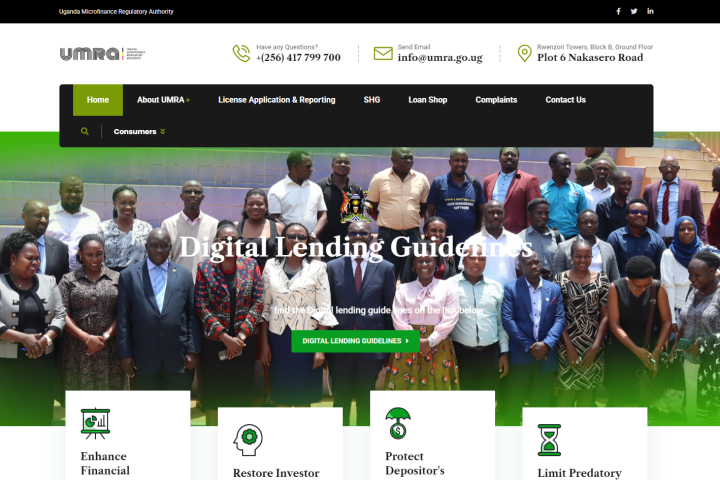
UMRA supervises SACCOs within its mandate. Qualifying large SACCOs fall under Bank of Uganda’s licensing framework.
Verify the exact institution’s current status with the relevant authority.
Savings groups
UMRA’s self-help-group guidelines provide for registration through the District Community Development Office or the equivalent office in cities and municipalities.
Group registration is not a commercial banking licence.
Banks
Commercial banks are licensed and supervised by Bank of Uganda.
For every option, use official records. An old certificate, website logo or historical licensing list does not independently establish current compliance.
8. Check Deposit Protection Carefully
Uganda’s Deposit Protection Fund protects eligible deposits at contributing institutions, subject to its rules.
The published standard limit is UGX 10 million per depositor per contributing institution. Personal accounts at the same institution are generally aggregated for this purpose.
Some SACCOs participate
Bank of Uganda reports the onboarding of licensed SACCOs to the DPF, and the Fund publishes participating SACCO information.
It is therefore inaccurate to assume either that every SACCO is covered or that none is covered.
Confirm the exact institution and eligible balance directly.
read Also;List of Best SACCOs in Malawi
Group money held in a bank
Do not assume every group member receives a separate protection limit merely because the group keeps money in a bank account.
Coverage depends on account ownership, records and applicable rules. Ask the bank and DPF how the particular arrangement is treated.
Registration alone does not insure a group’s internal cash, outstanding loans or every member contribution.
9. Consider Records and Payment Services
A bank may suit someone needing regular salary receipts, supplier transfers and downloadable statements.
A SACCO may provide useful savings and lending services, but confirm available payment channels.
A savings group may rely on passbooks, ledgers and meeting records. These can work well when maintained accurately.
Whatever the arrangement:
- Obtain receipts.
- Review balances.
- Investigate discrepancies.
- Keep your own records.
- Protect passwords and PINs.
Digital tools help, but do not replace reconciliation or independent oversight.
Which Option Might Suit Your Needs?
| Your main need | What to investigate |
|---|---|
| Salary and everyday payments | A suitable bank account |
| Saving with peers and building discipline | A well-run savings group |
| Member-based saving and credit | A verified SACCO |
| Emergency access | A product with dependable withdrawal access |
| International payments | A bank offering the required transfer services |
| Scheduled collective payout | A clearly governed rotating group |
| Fixed-period saving | Compare suitable deposit products and alternatives |
These are starting points rather than universal recommendations.
Can You Use All Three?
Yes, where membership and eligibility requirements permit.
For example, you might:
- Receive income through a bank.
- Participate in a group for a defined goal.
- Use a verified SACCO for a separate savings or credit need.
Keep the commitments affordable. Joining several groups can strain cash flow, especially when contributions and loan instalments fall due together.
Avoid borrowing from one arrangement simply to maintain appearances in another.
Checks Before Committing Money
For any provider or group, establish:
- Its identity and applicable status.
- Who controls funds.
- How transactions are authorised.
- When money can be withdrawn.
- All fees and contributions.
- Lending obligations.
- Available financial records.
- Complaint and exit procedures.
- Any protection claims.
Treat guaranteed unusually high returns, recruitment-driven rewards and pressure to pay immediately as reasons to pause.
Frequently Asked Questions
Is a SACCO safer than a savings group?
The answer depends on the institution, governance, finances and applicable safeguards. Verify these rather than relying on the category alone.
Are banks always more expensive?
No. Costs depend on the account and your transaction pattern. Compare total costs for equivalent use.
Does joining a group build a credit history automatically?
Not necessarily. Ask whether and how its records connect to any recognised credit-reporting arrangement.
Can a savings group become a SACCO?
It can explore the formal process, but growth or changing its name does not automatically create a SACCO. Seek registration and licensing guidance.
Where should I complain?
Start with the provider or group’s formal process. Escalation depends on the issue and responsible authority. Report suspected criminal conduct to police.
Read Also: Kenya Financial Sector Jobs Rise as Banks and SACCOs Expand