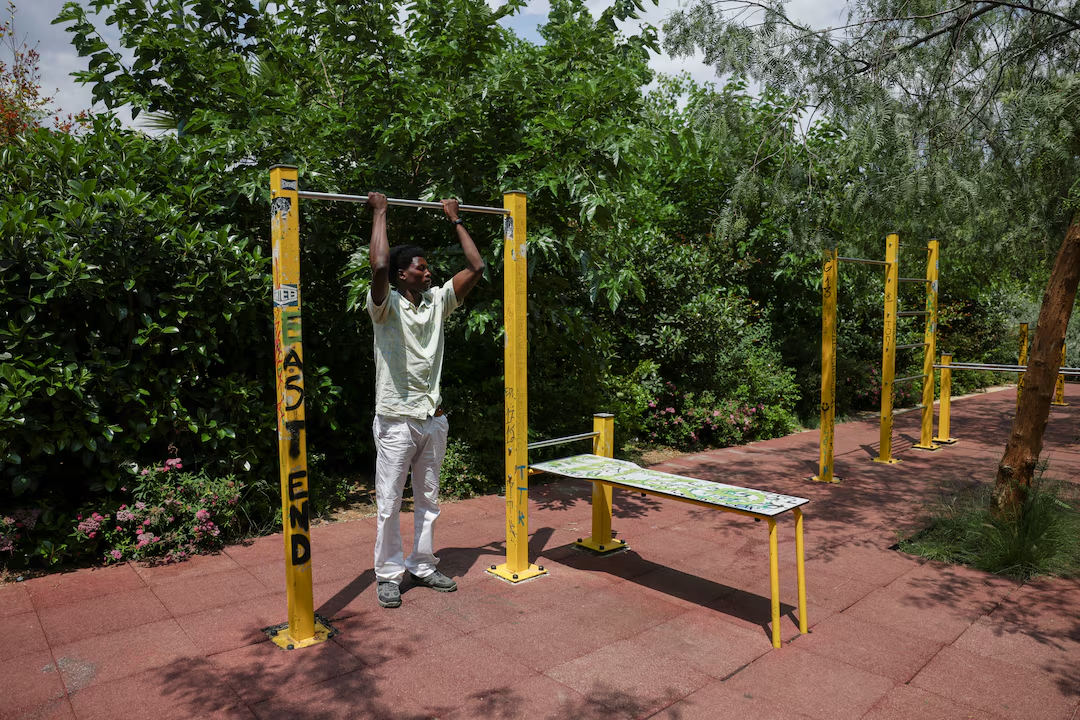
Bahr el-Din Yakoub fled Sudan after a missile strike destroyed his home in Khartoum and killed four of his friends. He sought safety in Egypt. But economic hardship and a harsh crackdown on refugees drove him further north.
He travelled dangerous desert routes to reach Libya. From there, he boarded a boat to Crete in Greece. Yakoub, 25, is among a growing group of Sudanese refugees in Libya. They say life in Egypt became impossible.
Tens of thousands of Sudanese have crossed into Libya since war broke out in April 2023. But a new trend is emerging. More refugees are now fleeing Egypt itself, not just Sudan.
Reuters interviewed 32 Sudanese refugees for this story. Most had left Egypt for Libya, Greece, or France. Only a few remained in Egypt.
More Sudanese are now risking the journey to Europe. In the first five months of 2025, Sudanese arrivals in Europe rose by 134% from a year earlier. This spike came even as total crossings from North Africa fell, according to UNHCR.
“The sea was rough. The trip was hard. But Libya had broken us. We had no choice—either cross or die,” Yakoub said. He recounted arrests, detentions, and abuse by Libyan authorities and militias.
Europe has backed the Libyan coastguard. Many migrants stopped at sea are returned to detention centres. A 2023 U.N. mission found that crimes against humanity had occurred in some of these centres.
Major General Ibrahim Al-Arbd, who oversees migration in eastern Libya, said that 20,000 to 25,000 Sudanese crossed into Libya from Egypt since the war began. He added that many had refugee status in Egypt but were unable to settle due to high costs.
As of May, 200 to 250 Sudanese were entering Libya each week. He expected numbers to rise during the summer.
‘FLEEING FROM EGYPT, NOT JUST SUDAN’
Since Sudan’s civil war started, over four million people have fled to neighbouring countries. About 1.5 million went to Egypt.
At first, Egypt allowed most Sudanese to enter visa-free. But after a surge in numbers, it introduced restrictions. As a result, many had to use smugglers to reach Egypt.
Gaining legal residency in Egypt also became harder. A 2023 policy required a $1,000 deposit to apply for residency. For many refugees, this was unaffordable.
Egypt’s Foreign Ministry did not respond to questions from Reuters. Mahmoud Fawzi, Egypt’s Minister for Legal and Political Affairs, denied that Sudanese face discrimination. He insisted no one was deported unless they broke the law or chose to return home.
Still, a crackdown in 2024 raised fears. Refugees without documents risked arrest and deportation. This included some already registered with UNHCR, according to three Egyptian migration lawyers.
A new asylum law passed in late 2024 shifted refugee registration from the UNHCR to the Egyptian government. Rights groups say the law increased police powers and stripped legal protections.
Mohamed Lotfy, head of the Egyptian Commission for Rights and Freedoms, said the law left many refugees exposed. “They can’t return to Sudan, and now they don’t feel safe in Egypt either,” he said.
‘I COULDN’T STAY IN EGYPT’
After fleeing Khartoum, Yakoub moved several times within Sudan. He eventually paid smugglers to reach Egypt. He thought it would offer safety.
Instead, he slept on Cairo’s streets for days, waiting to register with UNHCR. He gave up due to the long delays.
He shared a cramped apartment with eight other Sudanese and worked as a day labourer. But with no legal papers, he risked arrest. When crackdowns began, he decided to flee again—this time to Libya.
“The conditions weren’t suitable for a refugee,” he said from a migrant camp near Athens. “I was always hiding. I couldn’t stay.”
In Libya, things got worse. He said he was detained and mistreated. Yet, two months later, he boarded a dinghy with 50 others, most of them Sudanese, bound for Greece.
Critics say Egypt’s new asylum law uses vague terms to deny refugee status. Lotfy’s group has documented dozens of deportations involving refugees with valid UNHCR papers. He said police often confiscated documents before deporting them.
Fawzi denied these claims. He said no registered refugees had been deported. Deportation data is not published. But two security sources said about 21,000 Sudanese had been deported by March 2025 for illegal residence or other violations.
Amnesty International reported that some of these migrants were held in cruel conditions. They called the deportations a violation of international law.
‘LEVERAGING MIGRATION FOR AID’
Egyptian officials argue they’ve shown generosity, hosting over 1.5 million Sudanese during economic crisis. Fawzi said all migrants benefit from subsidies.
But migrants and a leaked EU Commission report dispute this. The report said migrants are excluded from most aid and many are food insecure. This drives onward migration.
Western diplomats say Egypt uses the migration crisis to pressure the EU for aid. Tineke Strik, an EU lawmaker, said that during a December visit, Fawzi told her: “Imagine if our border guards took a four-week holiday. What would happen?”
“They’re using migration as leverage,” she said.
In March, the EU announced a €7.4 billion aid package to Egypt aimed at curbing migration. Rights groups say such deals overlook human rights abuses and focus too much on returns and deportations.
SURGING NUMBERS VIA EASTERN ROUTE
Yakoub reached Greece by boat via the Eastern Mediterranean route. Frontex said this was the second most-used path into Europe between January and April. Some 12,228 people crossed this way.
While overall crossings fell, the number of Sudanese soared. From January to May 2025, about 1,469 Sudanese took this route—up from just 361 a year earlier.
Now in Greece, Yakoub is finally thinking about the future. “If Greece offers me safety and stability, I will stay.”