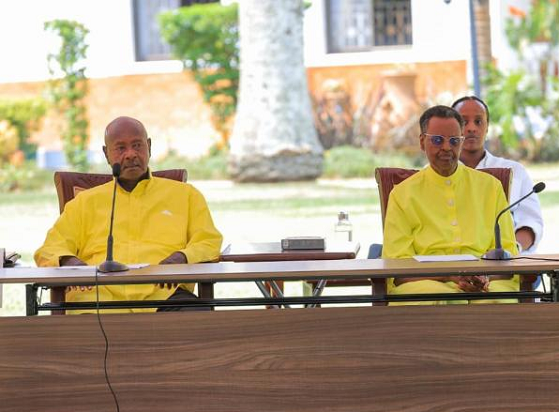
Oil revenues investment will shape Uganda’s economic direction in the coming years, President Yoweri Kaguta Museveni said while accepting his re-election declaration. Speaking at his country home in Rwakitura, the President pledged disciplined leadership, unity, and firm action to eliminate poverty as oil production draws closer.
The National Resistance Movement Central Executive Committee formally handed Museveni the declaration after provisional results showed he secured more than seven million votes. During his address, he thanked God, the First Lady Janet Museveni, party leaders, and national institutions for their support. According to him, the outcome reflected public confidence in stability and long-term economic planning.
However, Museveni noted that voter turnout revealed gaps the party must examine. Millions of NRM supporters did not vote, a trend he said requires urgent analysis. At the same time, he linked the result to renewed unity, especially in regions that previously experienced conflict, adding that peace has steadily returned to northern and eastern Uganda.
Oil revenues investment focused on durable infrastructure
Uganda’s oil production is expected to begin this year, Museveni confirmed, marking a critical economic milestone. He explained that oil revenues investment must prioritize projects that will benefit the country long after oil reserves decline. Key areas include railways, power stations, national roads, and science-based education.
Rather than distributing oil income directly to local governments, Museveni urged leaders to invest carefully. Since oil is a finite resource expected to last about 20 years, he argued that short-term spending would harm future generations. Therefore, channeling funds into productive infrastructure, he said, would strengthen industrial growth and national resilience.
Oil revenues investment linked to poverty eradication
Beyond infrastructure, oil revenues investment must support household-level poverty reduction, Museveni said. He noted that about 70 percent of Ugandans already operate within the money economy and need support to expand. Meanwhile, the remaining 30 percent require targeted interventions to move beyond subsistence.
To address this gap, Museveni highlighted the Parish Development Model as a central tool. The program, he said, has restored hope by funding income-generating activities at the grassroots. Still, implementation has varied across regions. As a result, he called for careful evaluation to identify weaknesses and improve delivery.
Read Also
Early tax submissions
Doing business in Uganda
Uganda private sector outlook
Security, unity, and political responsibility
Economic progress, Museveni said, depends heavily on peace and responsible politics. He praised the armed forces for maintaining security and thanked religious and cultural leaders for promoting calm. In addition, he noted that ordinary citizens across political divides play a vital role in preserving stability.
Nevertheless, the President warned groups involved in politically motivated violence to abandon such actions. Uganda, he said, will not tolerate disorder driven by foreign interests. Importantly, maintaining peace protects investor confidence, especially as oil revenues investment begins to influence national finances.
Jobs, services, and firm action on corruption
On employment, Museveni emphasized agriculture, manufacturing, and private enterprise as the main job creators. Public service jobs, he said, cannot absorb the growing workforce. Instead, productive sectors must lead job creation and income growth.
At the same time, he reaffirmed support for free education in government schools and better healthcare delivery. Corruption, he added, continues to frustrate citizens. For that reason, Museveni promised strict action against misuse of public funds and urged leaders to closely monitor hospitals, land protection, justice delivery, roads, and water access.
Economic outlook driven by oil revenues investment
Looking ahead, Museveni described oil revenues investment as a catalyst rather than a solution on its own. By combining infrastructure spending with targeted poverty programs, Uganda can achieve inclusive growth. Ultimately, he urged unity and discipline as the country enters a new economic era, stressing that stability remains the foundation of development.