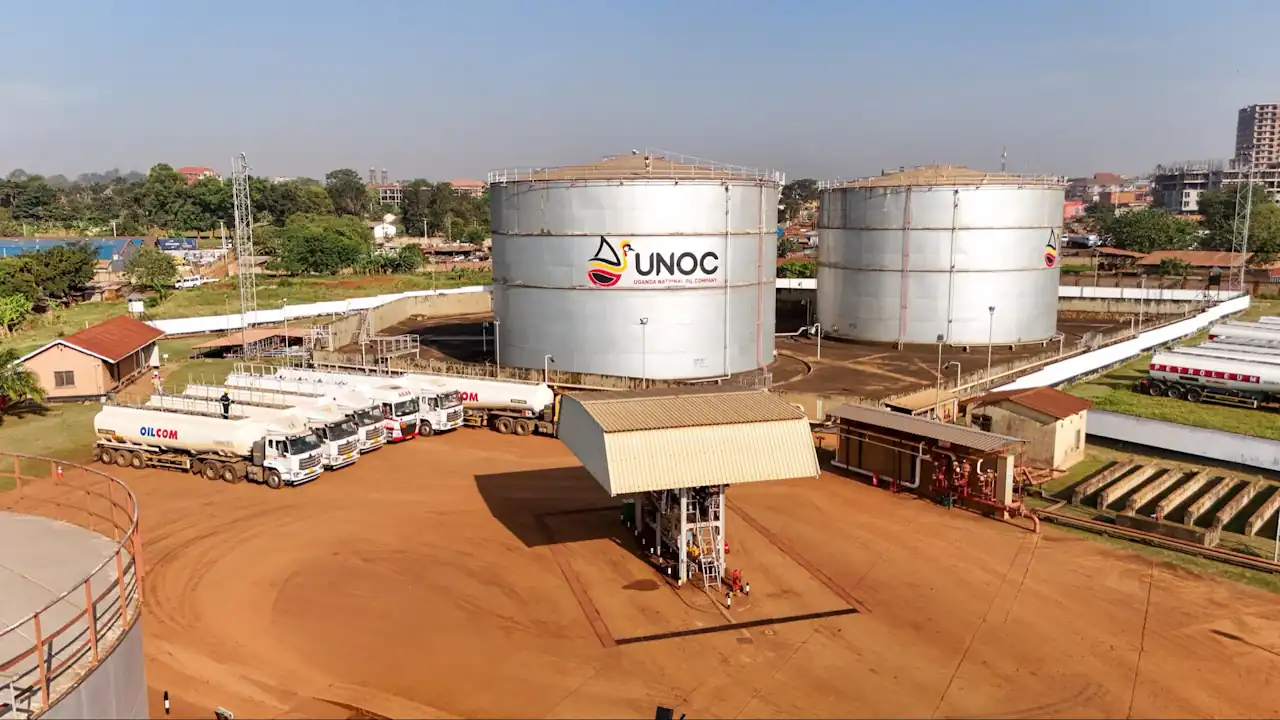
The 320-million-litre facility in Mpigi is expected to strengthen Uganda’s fuel reserves and eventually connect to the planned Hoima refinery.
President Yoweri Museveni has launched construction of the Kampala Storage Terminal, a major fuel storage project that is expected to give Uganda a much bigger safety cushion when petroleum supplies are disrupted.
The Sh1.15 trillion facility is being developed by the Uganda National Oil Company at Namwabula in Mpigi District, about 26 kilometres west of Kampala.
Once complete, it will be able to store up to 320 million litres of petrol, diesel, aviation fuel and kerosene.
That is a huge increase compared with the storage Uganda currently has under government control, and it comes at a time when the country is preparing for domestic oil production and a much bigger role in its own petroleum supply chain.
Kampala Storage Terminal starts taking shape
Museveni broke ground for the Kampala Storage Terminal on September 17, officially setting construction in motion.
Although the project carries the Kampala name, it is being built in Mpigi, where there is enough land for the large tanks, loading facilities and supporting infrastructure the terminal will need.
The site covers roughly 300 acres and is expected to serve Kampala, central Uganda and other parts of the country.
It will also provide storage space for government reserves and petroleum companies.
For a country that uses around 240 million litres of fuel every month, the 320-million-litre capacity is significant. If fully stocked, the terminal could theoretically hold more than a month of current national consumption.
Museveni, however, said Uganda should eventually aim for an even bigger reserve.
His argument was simple: a country that depends heavily on fuel coming through neighbouring states should be prepared for a situation where those supply lines are interrupted for weeks.
Why Uganda wants more fuel in storage
Uganda is landlocked, which means almost all of the refined petroleum it uses has to travel long distances before reaching local filling stations.
Much of the fuel first arrives at ports on the Indian Ocean before moving inland through Kenya or Tanzania.
That system works most of the time, but it also leaves Uganda exposed.
A problem at a port, along a railway, on a highway or at a border crossing can quickly affect supplies. Regional political instability or major global disruptions can create the same problem.
The idea behind the new storage terminal is to give the country more breathing room.
Instead of depending on a steady flow of fuel arriving every day, Uganda would have a much larger reserve to draw from during an emergency.
The government already has storage capacity at Jinja, but it is far smaller.
The Jinja Storage Terminal can currently hold about 30 million litres, with plans to add another 10 million litres.
When the Mpigi project and the Jinja expansion are complete, Uganda would have roughly 360 million litres of government-managed storage capacity.
The terminal is also part of Uganda’s oil plans
The Kampala Storage Terminal is not being built only for imported fuel.
In the long term, it is supposed to become part of Uganda’s own oil industry.
The government plans to connect the terminal to the proposed Hoima refinery through a multi-products pipeline stretching roughly 211 kilometres.
That would allow petrol, diesel and other refined products produced in Hoima to move directly to the Mpigi terminal for storage and distribution.
The planned Hoima refinery is expected to process up to 60,000 barrels of crude oil a day.
If all the projects come together as planned, Uganda would be able to produce crude oil in the Albertine region, refine part of it locally and then move the finished products to a major storage and distribution centre near Kampala.
That is very different from the country’s current dependence on imported refined fuel.
Uganda is getting closer to oil production
The timing of the project is important because Uganda is moving closer to commercial oil production.
The country has been developing the Tilenga and Kingfisher oil projects in the Albertine region, alongside the East African Crude Oil Pipeline.
Earlier this month, Museveni unveiled “Pearl Sweet” as the official name for Uganda’s crude oil.
The country eventually expects production from its oil fields to reach about 230,000 barrels a day.
Some of that crude is expected to be exported through the pipeline to Tanzania, while another portion is meant to supply the planned refinery in Hoima.
The Kampala Storage Terminal would sit at the other end of that domestic supply chain.
For ordinary consumers, that could eventually mean fuel produced from Ugandan crude moving through Ugandan infrastructure before reaching service stations around the country.
Museveni questions Uganda’s small fuel reserves
At the launch, Museveni questioned why Uganda had allowed fuel demand to rise so much while strategic storage remained relatively small.
The country consumes around 240 million litres of petroleum products each month, yet government-owned storage has remained only a fraction of that.
His concern is that Uganda could find itself in difficulty if regional supply routes were cut for an extended period.
That risk is not entirely theoretical.
Ugandans have seen fuel prices and supplies come under pressure before when transport routes were disrupted or global oil markets became unstable.
A much larger reserve would not prevent every price increase, but it could give the country more options during a short-term shortage.
Hundreds of fuel trucks could use the terminal every day
The project will involve much more than simply building storage tanks.
Plans include loading and unloading facilities, internal roads, electricity, water systems, ICT infrastructure and space for future railway connections.
Once it is fully operational, the terminal is expected to handle around 450 fuel trucks a day.
That gives an idea of just how busy the facility could become.
Its location in Mpigi is also practical.
It is close enough to Kampala, the country’s biggest fuel market, while avoiding the space and congestion problems that would come with trying to build such a large facility inside the capital.
The project could create opportunities for local companies
A project worth more than Sh1 trillion will require a wide range of contractors, suppliers and workers.
Construction alone is expected to create demand for civil engineering, mechanical work, transport, security, environmental services and logistics.
Ugandan businesses will be watching closely to see how much of that work is awarded locally.
Once construction is complete, the terminal will also need permanent staff to run storage operations, manage loading facilities, maintain equipment and handle safety systems.
The long-term economic value of the project will therefore depend not only on fuel security, but also on how much local participation is built into its construction and operation.
Uganda also wants to become a regional fuel hub
The government’s ambitions do not stop at supplying the local market.
Uganda wants the terminal to eventually become part of a wider regional petroleum network.
With the right road, rail and pipeline connections, fuel stored in Mpigi could potentially serve neighbouring markets as well.
Uganda is also looking at other ways of moving fuel into and around the country, including greater use of Lake Victoria.
The wider goal is to avoid depending too heavily on one route.
For a landlocked country, having several ways to move fuel can make a major difference when one transport corridor runs into trouble.
What the Kampala Storage Terminal means for Uganda
The new terminal is one piece of a much bigger transformation taking place in Uganda’s energy sector.
The country is building oil fields, pipelines, storage facilities and plans for a refinery at roughly the same time.
Each project serves a different purpose, but they are meant to work together.
The oil fields produce crude. The East African Crude Oil Pipeline provides an export route. The planned refinery would turn some of that crude into usable petroleum products. The Kampala Storage Terminal would then help store and distribute those products closer to the country’s biggest market.
That is the long-term vision.
For now, construction is only beginning, and the real test will be whether the project is delivered on schedule and within budget.
But if completed as planned, the 320-million-litre Kampala Storage Terminal would give Uganda something it has lacked for years: a much larger fuel reserve and a major distribution centre ready for the era of domestic oil production.