Uganda has talked about industrialisation for decades. Successive governments have promised more factories, better jobs, stronger local industries and an economy that produces more of what it consumes.
For many Ugandans, however, the promise of industrial transformation has often felt distant. Factories are announced, projects are launched and ambitious targets are unveiled, yet young people continue searching for employment while businesses struggle with the cost of production.
That is why the growing involvement of the National Enterprise Corporation (NEC) in Uganda’s industrial development deserves attention.
Best known as the commercial arm of the Ministry of Defence and Veteran Affairs and the Uganda People’s Defence Forces (UPDF), NEC has gradually moved into activities that extend far beyond the traditional responsibilities of a military institution.
Today, its interests range from agriculture and food processing to engineering, construction, manufacturing and industrial research.
The idea behind this expansion is relatively straightforward: Uganda should be able to produce more of the goods it needs, develop its own technical expertise and create economic opportunities through local industries.
But turning that idea into reality is where the difficult work begins.
Why NEC Matters to Uganda’s Industrial Transformation
Uganda is not short of resources or ambition.
The country has fertile agricultural land, a growing workforce and access to regional markets. What has often been missing is the industrial capacity to turn these advantages into products that command higher value.
Consider agriculture. Uganda produces substantial quantities of coffee, milk, maize, livestock and other commodities. Yet a significant share of the economic value associated with these products is generated further along the processing, packaging and distribution chain.
That is one of the gaps industrialisation is supposed to address.
Rather than relying heavily on exporting raw materials and importing finished products, Uganda wants to strengthen industries that process local resources and manufacture goods within the country.
NEC has become one of the institutions participating in that effort.
Established in 1989, the corporation was designed to undertake commercial activities while supporting the welfare and economic interests of the defence establishment.
Over time, its operations have grown to include enterprises with a much wider civilian economic role.
The question is no longer simply what NEC can produce for the military. It is also what NEC can contribute to Uganda’s broader industrial development.
From Defence Operations to Factories and Farms
There is something unusual about a military-linked corporation becoming involved in food processing, agricultural production, construction and industrial technology.
Yet the connection is not as surprising as it first appears.
Military institutions often develop practical expertise in logistics, equipment maintenance, engineering and large-scale project coordination. These are skills that can also be useful in civilian industries.
NEC has sought to apply some of that experience through its subsidiaries and commercial partnerships.
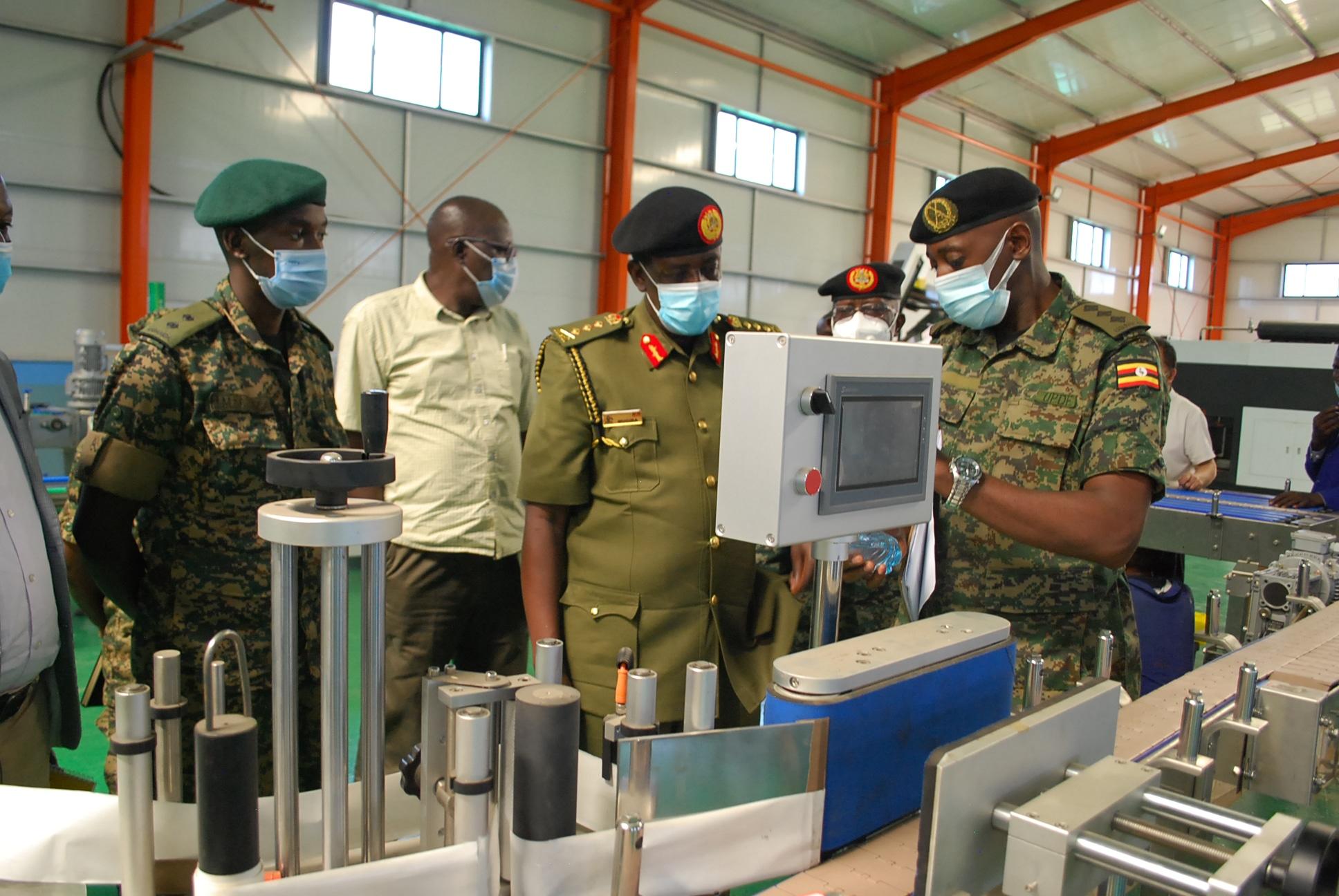
At Luwero Industries in Nakasongola, for example, the corporation has developed capabilities in specialised manufacturing, metal fabrication, equipment maintenance and engineering.
These may sound like highly technical activities, but their importance becomes clearer when viewed from the perspective of an ordinary Ugandan manufacturer.
A factory owner whose machine breaks down may have to wait for replacement parts from abroad. That delay can mean lost production, missed customer orders and additional expenses.
Building local engineering and fabrication capacity could help reduce some of these problems.
It could also create opportunities for Ugandan technicians to learn how industrial machinery works, how components are manufactured and how equipment can be maintained.
Such knowledge is essential if Uganda wants to build industries that can eventually design and produce more of their own machinery.
Agriculture Could Be NEC’s Biggest Opportunity
For Uganda, the connection between farming and industrialisation is especially important.
Agriculture supports millions of livelihoods, but many farmers still struggle with unpredictable prices, limited storage facilities and weak connections to processing companies.
One way to improve this situation is to establish industries that purchase agricultural produce locally and turn it into finished products.
NEC has entered this space through agricultural enterprises and food-processing investments.
In July 2026, President Yoweri Museveni commissioned the NEC Meat and Beans Processing Factory at Katonga in Gomba District.
The facility, developed through a partnership involving NEC and a Kenyan investor, was established to support the processing of livestock and agricultural products.
Its reported capacity to process 150 animals per operating day points to the scale of the opportunity.
For livestock farmers, a processing plant can mean another potential buyer for their animals. For transporters, it can create demand for delivery services. For workers, it can open opportunities in processing, packaging, equipment maintenance and distribution.
But there is an important distinction between building a factory and creating a functioning agricultural value chain.
A processing facility needs a consistent supply of quality products, dependable electricity, trained employees and buyers for its finished goods.
If farmers cannot supply enough produce or the products cannot compete in the market, even a well-equipped factory can struggle.
That is why NEC’s agricultural investments should be judged not only by their production capacity but also by how much business they generate for farmers and other local suppliers.
NEC’s Industrial Parks Offer Another Opportunity
Industrial parks have become a familiar part of Uganda’s development plans.
The thinking is that manufacturers are more likely to invest where land, electricity, roads, water and other essential services are available in one location.
NEC is pursuing a similar approach through its T6 Industrial and Business Park in Nakasongola.
The project is intended to accommodate a range of industrial activities, including manufacturing, agricultural processing, medical technology and related services.
One of the developments associated with the park is the Pathogen Economy Biosciences Park, whose groundbreaking ceremony took place in February 2025.
The initiative is intended to encourage research and the development of biomedical products.
For Uganda, this is an area with considerable potential.
The country has experienced infectious disease outbreaks and other public health challenges that have demonstrated the importance of reliable medical supplies, laboratory capacity and scientific research.
Developing stronger domestic capabilities in these fields could make Uganda less dependent on imported products while creating specialised jobs.
However, research facilities and industrial parks require sustained financing, technical expertise and access to markets.
Their long-term value will depend on whether they attract operating businesses, develop useful technologies and produce goods that people and institutions are willing to purchase.
An industrial park filled with functioning enterprises is far more valuable than one that exists mainly in development plans.
Uganda Needs More Than New Factories
There is a tendency to measure industrial progress by the number of factories opened or the value of investments announced.
These figures matter, but they do not tell the entire story.
A factory can be impressive from the outside and still operate far below its intended capacity.
It can have modern machinery but struggle to find skilled operators. It can produce quality goods but fail to compete because transport and electricity are too expensive.
These are challenges Uganda must confront if industrialisation is to deliver meaningful results.
For NEC, this means focusing on the commercial performance of its enterprises as much as their physical expansion.
Factories need customers. Production lines need reliable supplies. Businesses need managers who understand costs, quality control and market demand.
The corporation must also demonstrate that public investment is being used effectively.
Because NEC is associated with the defence establishment, its commercial activities raise legitimate questions about transparency, accountability and competition.
A strong industrial economy needs both effective public institutions and successful private companies.
NEC’s contribution will be greatest when it helps create opportunities for other Ugandan businesses rather than becoming an obstacle to their growth.
Young Ugandans Must Be Part of the Industrial Story
One of the strongest arguments for Uganda’s industrial transformation is employment.
Every year, young Ugandans leave universities, technical institutions and vocational training centres hoping to find work.
Many have qualifications but struggle to gain the practical experience employers require.
Industrial expansion could help bridge this gap.
NEC’s engineering workshops, manufacturing operations, agricultural enterprises and construction projects all have the potential to provide practical training and employment.
A young mechanical engineering graduate, for instance, could gain experience maintaining production machinery.
An electrical technician could develop skills in industrial power systems, while an agricultural graduate could learn about commercial farming and food processing.
These experiences could eventually help workers establish their own businesses or move into other industries.
But creating these opportunities requires deliberate investment in apprenticeships, vocational training and partnerships with educational institutions.
Simply announcing an industrial project does not guarantee that local young people will benefit from it.
Employers must be prepared to train workers, and training institutions need to equip students with skills that industries actually require.
Uganda’s industrial future will ultimately depend as much on the abilities of its people as on the machinery installed in its factories.
The Private Sector Cannot Be Left Behind
NEC may be an important participant in industrial development, but it cannot transform Uganda’s economy on its own.
Private manufacturers, farmers, transport companies, financial institutions and small enterprises all have roles to play.
In fact, some of the greatest benefits of industrial investment emerge outside the factory itself.
A food-processing company may buy produce from hundreds of farmers. A manufacturing plant may require packaging materials, transport services, spare parts and equipment repairs.
Each of these needs creates potential business for another enterprise.
This is how industries begin to support one another.
NEC could contribute to that process by creating stronger links between its operations and locally owned businesses.
Where practical, local suppliers should have opportunities to compete for contracts, participate in supply chains and acquire the technical knowledge needed to meet industrial standards.
That would allow the benefits of industrial investment to spread beyond NEC’s own operations.
It would also help Uganda develop the wider business ecosystem needed to sustain industrial growth.
The Difficult Question of Sustainability
There is no shortage of ambitious development projects in Uganda.
Some have delivered meaningful results. Others have struggled with financing, management challenges, delayed implementation or limited market demand.
NEC’s industrial ventures will face many of the same pressures.
Government support can help establish an enterprise, but long-term success depends on whether the business can operate efficiently and generate sufficient revenue.
This is particularly important in manufacturing, where production costs can quickly undermine competitiveness.
Electricity, transport, imported machinery, financing and raw materials all influence the final price of a product.
If a locally manufactured product is consistently more expensive or less reliable than an imported alternative, customers may have little incentive to buy it.
NEC therefore needs to combine its development objectives with commercial discipline.
This means understanding markets before expanding production, maintaining equipment, controlling costs and investing in product quality.
It also means being open about performance.
The public should be able to understand how industrial investments are contributing to employment, production, local sourcing and national economic development.
Without measurable results, industrial transformation risks becoming another attractive promise rather than a lasting economic achievement.
What Industrial Transformation Should Mean for Ordinary Ugandans
For a young person searching for a job in Kampala, industrialisation should mean more opportunities to earn a living.
For a farmer in Gomba, it should mean access to reliable markets and better opportunities to sell produce.
For a small engineering business in Jinja, it could mean supplying parts or services to a larger manufacturer.
For a household struggling with the cost of imported products, it could eventually mean more affordable, locally produced alternatives.
These are the practical changes that should define Uganda’s industrial transformation.
The country does not need factories simply for the sake of having factories.
It needs industries that solve problems, employ people, support other businesses and create products that can compete in domestic and regional markets.
NEC’s expanding industrial activities offer one possible route towards that future.
But the corporation’s achievements will be judged by what happens after the ribbon-cutting ceremonies, when the cameras have left and the difficult business of running factories begins.
NEC’s Place in Uganda’s Industrial Future
Uganda’s ambition to become a more productive and industrialised economy is not new.
What matters now is whether the country can build institutions and businesses capable of sustaining that ambition.
NEC has already established a presence in manufacturing, engineering, agriculture, construction and industrial development.
That gives it an opportunity to contribute to something much larger than its original commercial mandate.
Yet its success should not be measured solely by the size of its investments or the number of projects under its name.
The more meaningful questions are whether those investments are creating lasting jobs, building Ugandan technical expertise, supporting farmers and strengthening local industries.
Industrial transformation is rarely achieved through one major project or institution. It is a gradual process that requires reliable infrastructure, skilled people, competitive businesses and policies that encourage investment.
NEC can be part of that process, but it must work alongside Uganda’s private sector, research institutions and farming communities.
Ultimately, the promise of industrial transformation will mean little if ordinary Ugandans cannot see its benefits in their daily lives.
The real achievement will come when Uganda is not merely opening factories, but keeping them productive; not merely training graduates, but employing their skills; and not merely producing raw materials, but turning them into goods that compete beyond its borders.
That is the opportunity before NEC.
And it is also the challenge facing Uganda as it seeks to turn decades of industrial ambition into lasting economic progress.