
Changing your name officially in Uganda involves more than adopting a new name socially. You need to follow the procedure appropriate to your circumstances and then update the official records you use.
For an adult adopting or dropping a name, NIRA’s published requirements identify a deed poll registered with the Uganda Registration Services Bureau and evidence of publication in the Uganda Gazette, together with supporting documents.
However, a spelling correction, a change connected with marriage and a child’s name change may require different documentation.
This guide explains how to identify the correct process, prepare your records and avoid inconsistencies across your National ID, passport, bank accounts and other documents.
First Decide Whether You Need a Name Change or a Correction
The reason for the application determines the procedure.
A typing error is different from choosing a new name. Likewise, explaining why existing documents contain different names is not necessarily the same as formally adopting another name.
| Your situation | What to establish |
|---|---|
| A name is misspelled on an official record | The issuing authority’s correction procedure |
| You want to add, drop or adopt a name | The applicable name-change and deed poll requirements |
| Your name is changing because of marriage or divorce | Supporting civil records and the authority’s specific checklist |
| Your documents use different versions of your name | Whether clarification, correction or a formal change is required |
| You want to change a child’s registered name | The parent or guardian application procedure |
| You want to remove a nickname or title | NIRA’s requirements for that particular category |
Do not pay for a generic affidavit before establishing which documents your application actually requires.
What Is a Deed Poll?
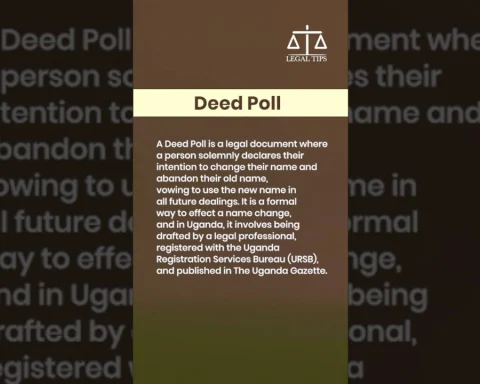
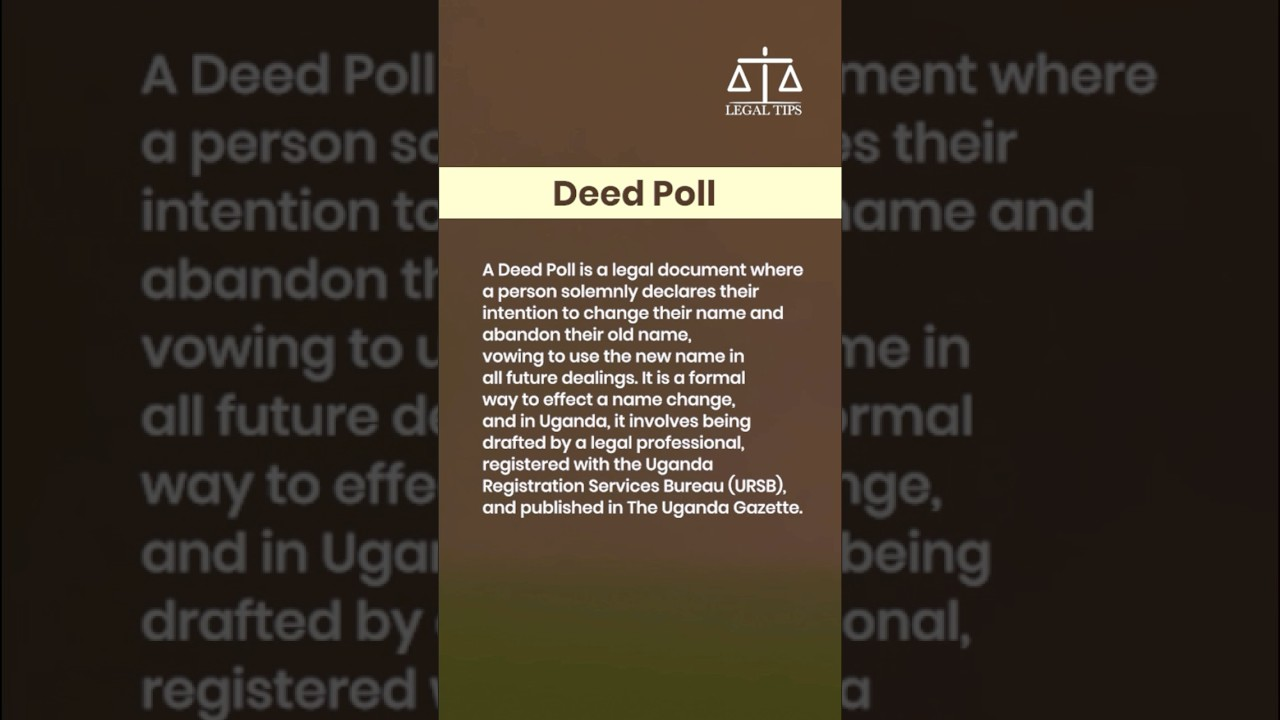
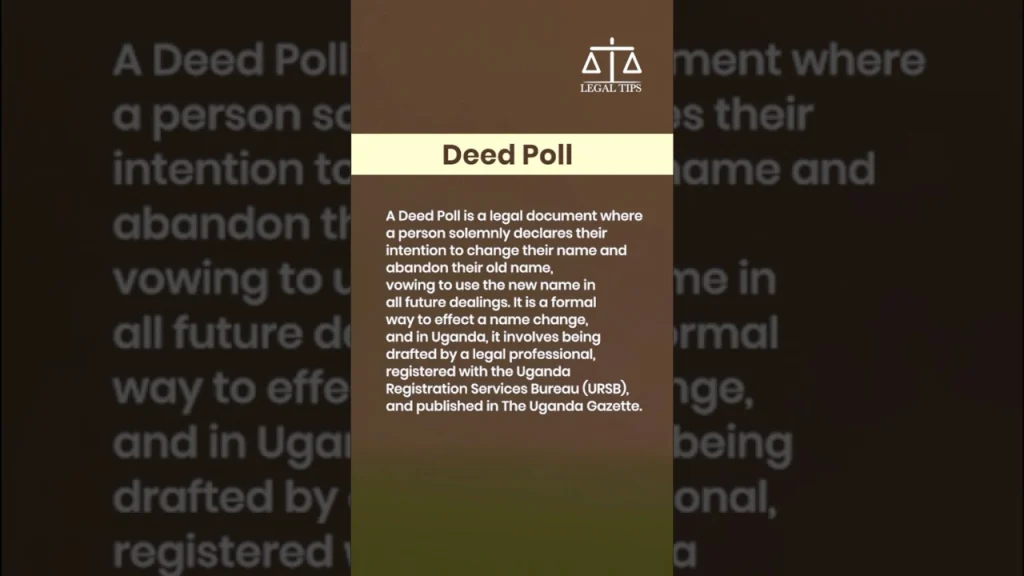
A deed poll is a formal document recording a person’s decision to abandon a former name and adopt another.
For a name-change application, it should identify the former and new names clearly and be prepared and executed correctly.
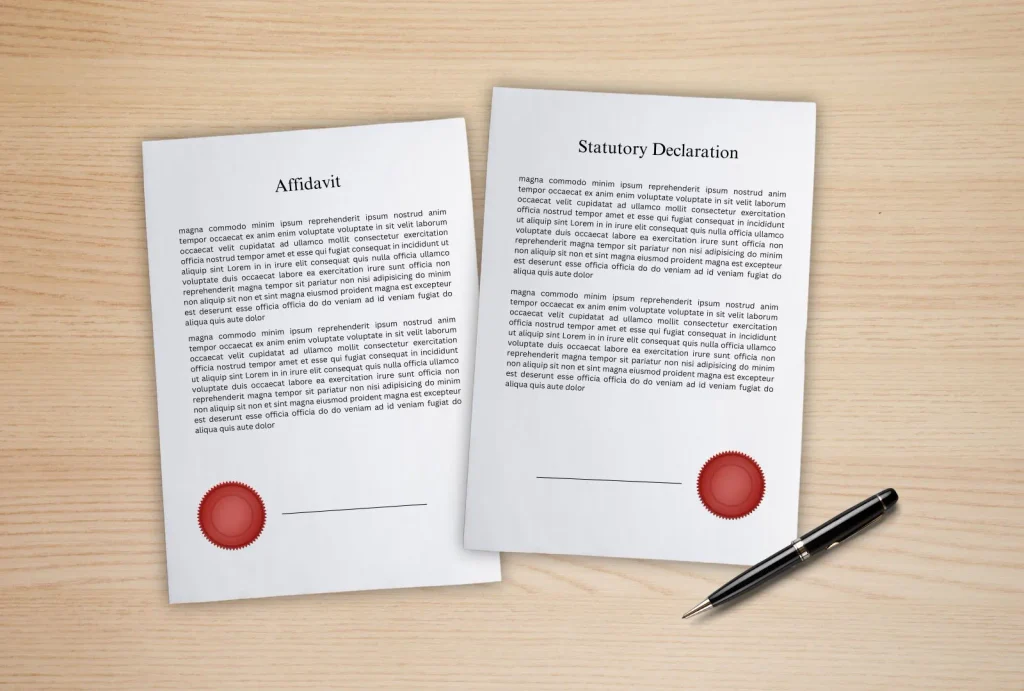
A deed poll is different from a statutory declaration explaining a discrepancy. It is also different from the application submitted to update a government register.
Preparing the deed poll, registering it, publishing the required notice and updating your records are separate steps.
Which Institutions Are Involved?
Several organisations may be involved, each performing a different function.
| Institution | Relevant role |
|---|---|
| URSB | Registration of the deed poll |
| Uganda Printing and Publishing Corporation | Publication in the Uganda Gazette |
| NIRA | Changes to the relevant identification and civil-registration records |
| Directorate of Citizenship and Immigration Control | Updating or replacing passport records through its applicable procedure |
| Banks, employers and other organisations | Updating their own records after reviewing your evidence |
Completion of one stage does not mean every institution has updated its records.
Documents to Prepare
Obtain the checklist for your particular application before commissioning documents.
Depending on the circumstances, prepare:
- Your National ID or other applicable identification.
- Birth certificate or birth-registration details.
- Existing passport, if you have one.
- Records showing the names currently used.
- Correctly prepared deed poll, where required.
- Evidence of URSB registration.
- Relevant Uganda Gazette notice.
- Marriage certificate or decree absolute, where applicable.
- Payment receipts.
- Completed application forms.
- Any supporting declaration specifically requested.
Take originals for inspection where required and retain clear copies.
Do not assume that a document required for one type of change is compulsory for every applicant.
How to Change Your Name in Uganda: Step by Step
Step 1: Confirm the Applicable NIRA Procedure
Explain whether you are adopting a new name, correcting an error or updating your name following marriage or divorce.
Ask NIRA which forms and evidence apply. If your birth record also needs amendment, establish whether that requires a separate application.
Clarify the process before paying for drafting, registration or publication.
Step 2: Choose the Exact Name You Will Use
Decide the complete spelling and order of your new names.
Check for:
- Missing or additional names.
- Inconsistent spelling.
- Hyphens or spaces.
- Differences between the proposed deed poll and application forms.
Once publication and registration have occurred, correcting an avoidable error may involve additional work and expense.
Step 3: Have the Deed Poll Prepared and Executed
Where a deed poll is required, obtain help from a qualified legal professional familiar with the process.
UPPC’s published guidance directs applicants to a commissioner for oaths for preparation before registration and gazetting.
Review the complete document before signing. Ensure that both the former and adopted names are accurate.
Follow the professional’s instructions for execution rather than signing an unfinished document in advance.
Step 4: Register the Deed Poll With URSB
Submit the executed deed poll through the applicable URSB legal-document registration process.
Confirm the current supporting-document requirements, payment assessment and submission method.
Keep the registered document and registration evidence securely. NIRA’s published guide specifically identifies an original deed poll duly registered with URSB for relevant name changes.
Step 5: Arrange Uganda Gazette Publication
UPPC’s published process describes submitting the registered deed poll for publication with proof of the prescribed payment.
Ask UPPC and NIRA to confirm the notice format required for your application. The Registration of Persons Act refers to a notice of intention to change a name.
Review the notice carefully before publication. Check the names and other identifying details against your registered documents.
After publication, obtain the relevant Gazette evidence and retain the issue date and page details.
An ordinary social-media announcement should not be treated as a substitute for publication in the Uganda Gazette.
Step 6: Confirm the Filing Date With NIRA
The published Act and regulations contain inconsistent wording about the seven-day period following publication.
Section 36 of the Registration of Persons Act states that the application may be made not less than seven days after publication. The published regulations use different wording.
Because of this discrepancy, confirm the correct filing date with NIRA before scheduling submission. Do not rely on an unofficial claim that you must apply immediately or that publication completes the process.
Step 7: Apply to Update the Relevant Register
Submit the required forms, Gazette evidence, registered deed poll and supporting records to NIRA.
For amendments to the birth register, section 36 identifies the registration centre where the birth is registered. Confirm with NIRA how to make the application through its current service arrangements.
Ask whether the request also covers your National Identification Register entry and whether a replacement card requires a separate assessment.
Step 8: Check the Updated Record and Documents
Review the resulting record or document before using it for further applications.
Check your full name, spelling and other personal particulars.
Keep the evidence connecting your former name to your new name. Other organisations may need it when updating their records.
Changing Your Name After Marriage or Divorce
Do not assume that presenting a marriage certificate automatically completes every record update.
NIRA’s published name-update guide lists the following for changes by marriage or divorce:
- Gazette notice.
- Original deed poll duly registered with URSB.
- Certified marriage certificate or certified decree absolute.
Confirm the checklist applicable to the exact change you want.
A divorce-related document should also be checked for the correct status. Do not assume that every court document concerning a divorce is the final decree required.
You should still contact each institution holding your records to establish how its name-update procedure works.
Correcting a Spelling Error
A spelling correction can follow a different route from adopting or dropping a name.
NIRA’s published guidance identifies a registered statutory declaration and supporting records for certain corrections.
Supporting evidence can help establish that an entry was recorded incorrectly. Explain the discrepancy clearly and provide consistent documents where available.
Do not describe a deliberate adoption of a different name as a typing error simply to avoid the appropriate process.
Removing Nicknames, Titles or Maiden Names
NIRA publishes separate guidance for certain changes involving nicknames, pet names, titles and maiden names.
Some of these categories identify a statutory declaration registered with URSB and supporting documents.
This is why it is important to describe your request precisely. “Changing my name” may refer to several different administrative categories.
Ask which category applies before arranging a deed poll or declaration.
How to Change a Child’s Name in Uganda
The Registration of Persons Act provides for an application by a child’s parents or guardian to the registration officer where the birth is registered.
The regulations identify a child-specific application form and require information about the child and the parents or guardian.
Before applying, ask NIRA about:
- Identification for the child and applicant.
- The child’s birth-registration record.
- Evidence of guardianship where relevant.
- Required parental involvement or consent.
- Supporting records.
- The applicable fee.
- Any additional steps arising from the family’s circumstances.
Do not assume that the adult deed poll procedure applies unchanged to every child.
If parental authority or consent is disputed, obtain advice before proceeding.
How Much Does It Cost to Change Your Name?
There is no single all-inclusive price covering every stage.
| Cost component | What to confirm |
|---|---|
| Professional preparation | Drafting and execution charges |
| URSB registration | Current assessment for the deed poll or other legal document |
| Gazette publication | UPPC’s applicable publication charge |
| NIRA register amendment | The fee for the particular name-change service |
| Replacement National ID | Whether a separate card charge applies |
| Passport update | Applicable immigration application and replacement charges |
| Additional documents | Certified copies, transport and courier costs |
Published Fee Examples
NIRA’s fees page lists UGX 150,000 for an adult change of name and UGX 20,000 for a child’s change of name under its birth-registration categories.
These should not be treated as the complete cost of changing every identity document.
UPPC’s published Gazette rate card lists UGX 450,000 for a deed poll notice. Confirm the notice category and current assessment directly before paying.
Some official pages show differing figures for National ID changes. Obtain a current assessment for your particular service instead of combining charges from different categories.
Keep official receipts for every stage.
Read Also; How to Legally Change Your Name in Timor-Leste (Deed Poll Process)
How Long Does the Process Take?
The total time depends on document preparation, registration, publication and record updates.
UPPC’s FAQ gives a general gazetting period of five to ten working days after submission, depending on the notice and completeness of requirements.
That is not a promise that the entire name-change process will be completed within the same period.
Allow time for:
- Professional preparation and execution.
- URSB processing.
- Gazette scheduling and publication.
- Any applicable waiting period.
- NIRA examination.
- Replacement identity documents.
- Updates by other organisations.
Avoid making travel or application commitments that depend on receiving updated documents by an unconfirmed date.
Which Records Should You Update Afterwards?
Create a checklist based on the documents and services you use.
| Record or account | What to ask |
|---|---|
| National ID | Whether the register and card both require updating |
| Birth record | Whether the amendment has been completed |
| Passport | Required evidence and replacement procedure |
| Bank accounts | Name-update and identity-verification requirements |
| Employer records | Payroll, contract, tax and benefits updates |
| URA records | Applicable taxpayer-detail amendment procedure |
| Driving licence | Name-change requirements |
| Insurance and pension records | Supporting evidence and beneficiary implications |
| Academic records | Whether amendment or a linking verification document is available |
| Professional registrations | Applicable regulator’s procedure |
| Mobile services | Accepted identification and update requirements |
A legal name change does not automatically reissue every historical document.
For academic records, ask the issuing institution whether it changes certificates or provides a way to link the old record to your current identity.
Common Mistakes to Avoid
Using Different Versions of the New Name
Choose one complete version and use it consistently throughout the process.
Treating Publication as the Final Step
Gazetting does not automatically amend your National ID, passport or bank records.
Relying on an Affidavit Alone
A general affidavit is not a substitute for a registered deed poll and Gazette evidence where those are required.
Losing the Link Between Names
Retain the registered documents and publication evidence. They may be needed long after the change.
Altering Existing Documents Yourself
Do not edit a scan of a certificate, identity card or passport. Use the issuing authority’s procedure.
Paying Without Confirming the Service
Ask what each charge covers and whether further payments will be needed.
Frequently Asked Questions
Can I Add or Drop a Name Officially?
NIRA publishes a procedure for adopting or dropping names. Obtain the appropriate checklist and complete the required registration, publication and record-update steps.
Can I Change My Name Through a Statutory Declaration Alone?
Certain corrections and specific categories may use statutory declarations. A declaration alone should not be assumed sufficient for a change requiring a deed poll and Gazette notice.
Does Marriage Automatically Update My National ID?
No. You must apply through the relevant NIRA process and provide the required supporting documents.
Must I Publish in a Newspaper?
The adult procedure discussed here identifies publication in the Uganda Gazette. Do not assume an ordinary newspaper notice replaces that requirement.
Will My Passport Change Automatically?
No. Contact the immigration authority about updating or replacing it.
Can I Apply While Living Abroad?
Contact NIRA and the relevant Ugandan mission before arranging execution or sending original documents. Confirm what can be handled remotely and which identity-verification steps require attendance.
Does Changing My Name Remove Existing Obligations?
Do not treat a name change as removing debts, contracts or other legal responsibilities. Maintain accurate links between your former and current identity.
Keep Your Records Consistent
Start by establishing whether you need a correction, an explanation of existing records or a formal name change.
Where required, prepare and register the deed poll, complete Gazette publication and apply to NIRA. Then update the other organisations holding your information.
A complete record connecting the former and new names will help you explain historical documents and avoid unnecessary identity mismatches.
Read Also: How to Change Your Name by Deed Poll in Akrotiri: Step-by-Step Guide