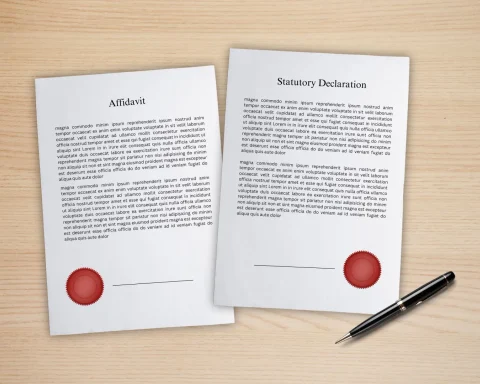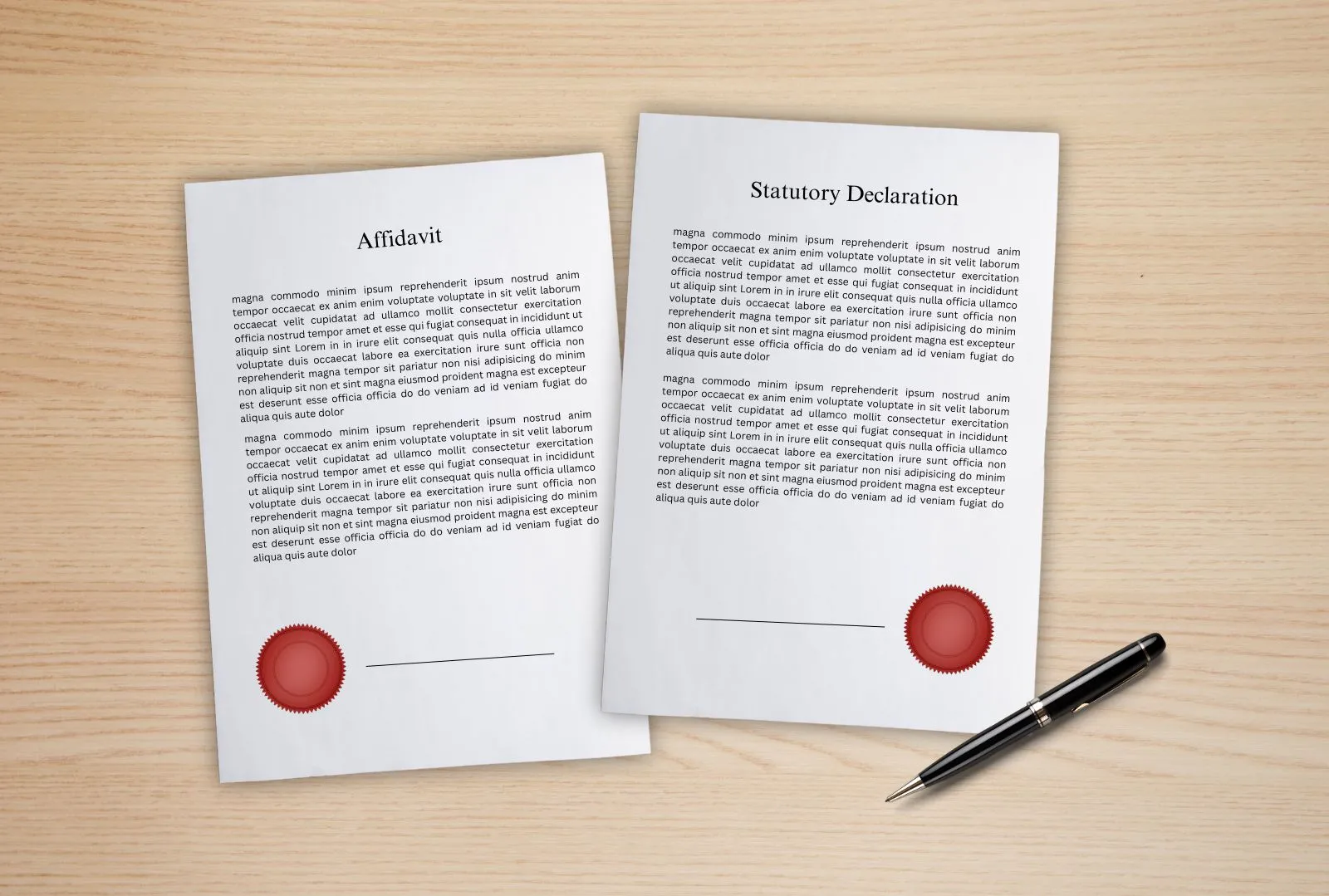

The main difference between an affidavit and a statutory declaration in Uganda is the legal purpose for which the statement is made.
Under the Statutory Declarations Act, affidavits are reserved for matters connected with courts or situations where written law authorises them. Statutory declarations provide the formal declaration route for other purposes covered by the Act.
Both documents carry legal responsibilities. A statutory declaration is not simply an informal or less important version of an affidavit.
Choosing the correct document matters when applying for government services, explaining differences in personal records or preparing documents for court. A familiar title or a commissioner’s stamp does not, by itself, establish that you have followed the correct procedure.
This guide explains the distinction, common practical situations and the questions to ask before signing.
Affidavit vs Statutory Declaration: Quick Comparison
| Feature | Affidavit | Statutory declaration |
|---|---|---|
| Basic nature | Written statement made on oath or affirmation | Formal statement declared to be true under the applicable statutory procedure |
| Main legal use in Uganda | Court-related matters or purposes authorised by written law | Other formal declarations falling outside those affidavit categories |
| Person making it | Commonly called the deponent or affiant | Called the declarant |
| Execution | Oath or affirmation before an authorised person | Declaration before an authorised person |
| Format | Governed by the relevant law, court rules and purpose | The Statutory Declarations Act prescribes a form |
| Registration | Depends on the applicable procedure | Required in specified circumstances or application processes |
| Effect on official records | Does not automatically amend a record | Does not automatically amend a record |
| Responsibility for accuracy | The maker is responsible for the statement | The maker is responsible for the statement |
The correct choice should follow the applicable law and the receiving authority’s requirements.
What Is an Affidavit?
An affidavit is a written statement of facts made on oath or affirmation before a person authorised to administer it.
It is commonly used to support court applications and other matters for which the relevant law permits an affidavit.
The person making the affidavit should understand its contents and be able to explain the facts stated.
An affidavit is not the same as an ordinary signed letter. Its execution involves a formal oath or affirmation, together with the authorised person’s endorsement.
What Is a Jurat?
The jurat is the part recording the administration of the oath or affirmation.
It commonly identifies the place, date and person before whom the affidavit was made.
Treat it as an essential part of execution. Do not complete it with an invented place or date, or assume that a stamp can replace the actual procedure.
What Is a Statutory Declaration?
A statutory declaration is a formal statement made under the statutory declaration procedure.
The person making it declares the stated facts to be true before an authorised person.
It is often relevant to administrative processes where a person must formally explain or confirm information. However, the particular service may prescribe additional evidence, wording or registration.
A declaration should be prepared for its actual purpose rather than copied from an unrelated application.
What Does Ugandan Law Say About the Difference?
Section 2 of the Statutory Declarations Act restricts affidavits to court-related matters and purposes authorised by written law. Section 3 provides for statutory declarations outside those categories.
The Act also addresses an affidavit made for a purpose outside section 2: it is treated as a statutory declaration.
That provision is not a reason to choose the title casually. Prepare the correct document from the start and check the complete requirements for its intended use.
Avoid the oversimplified rule that every document used outside a courtroom must be a statutory declaration. A written law may specifically authorise an affidavit.
When Should You Use an Affidavit?
Use an affidavit where the applicable legal procedure requires or authorises one.
For example, a court application may require evidence presented through an affidavit. The relevant rules determine the format, contents, exhibits and filing requirements.
Before drafting, establish:
- Which court or authority will receive it.
- What application or matter it supports.
- Who should make the statement.
- Which facts must be addressed.
- Whether exhibits are required.
- The deadline and filing procedure.
For a court matter, follow the relevant rules and obtain advice where necessary. A general internet template may omit details essential to your application.
When Should You Use a Statutory Declaration?
Use the statutory declaration procedure where it applies to the facts and purpose involved.
A practical example is a government process expressly requesting a registered statutory declaration.
NIRA’s published guidance identifies statutory declarations for certain changes or explanations concerning personal particulars. Other changes can require different documents.
The important question is not simply, “Does this involve my name?” It is, “Which procedure applies to this particular correction or change?”
A Declaration Is Supporting Evidence
A declaration may explain a discrepancy or confirm information, but the receiving authority still assesses the application.
It does not automatically:
- Correct a National ID.
- Change a birth register entry.
- Replace a lost academic certificate.
- Alter a passport.
- Establish entitlement to a benefit.
Follow the underlying service procedure and provide the required supporting records.
Who Can Take an Affidavit or Statutory Declaration?
Ugandan law recognises specified judicial officers and legal professionals for these functions.
Depending on the document and circumstances, these include commissioners for oaths, notaries public and authorised judicial officers.
A commissioner for oaths can also take statutory declarations. However, the Commissioners for Oaths legislation contains restrictions concerning matters in which the commissioner acts for a party or has an interest.
Ask the professional to confirm that they are appropriately authorised and able to act in your matter.
Do not assume that every advocate automatically holds every additional appointment or licence.
Commissioning and URSB Registration Are Different
These are separate stages.
Making the Statement
You make the affidavit or declaration before the authorised person, following the applicable procedure.
Registering the Document
Where required, the executed document is then submitted for registration through URSB.
URSB’s published guide provides a statutory declaration registration route involving the document’s subject, declaration date, declarant’s details, identification, payment and submission.
Registration is not a substitute for proper execution.
Likewise, a commissioned document has not necessarily completed every registration or application requirement.
Must Every Statutory Declaration Be Registered?
Avoid assuming that the answer is identical for every purpose.
Some administrative services expressly require a declaration registered with URSB. Confirm the requirement for the service you are using.
The Statutory Declarations Act also contains a specific rule for declarations made outside Uganda for use in Uganda: registration is required before such a declaration is admissible in evidence under that provision.
Explain the intended use when seeking professional advice, particularly if the document is being made abroad.
What About Name Differences and Name Changes?
People often confuse an explanation of existing records with a legal change of name.
For example:
- One document may contain a spelling error.
- Different documents may use different versions of a name.
- A person may wish to add or drop a name.
- A record may include a nickname or title.
These situations do not necessarily follow the same procedure.
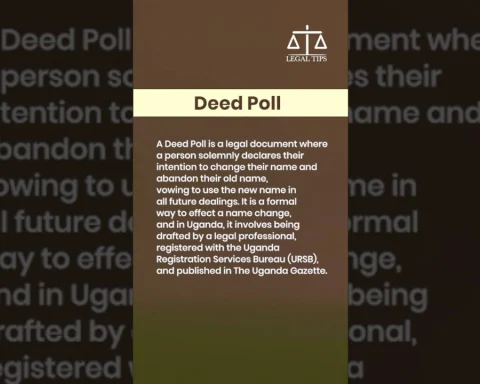
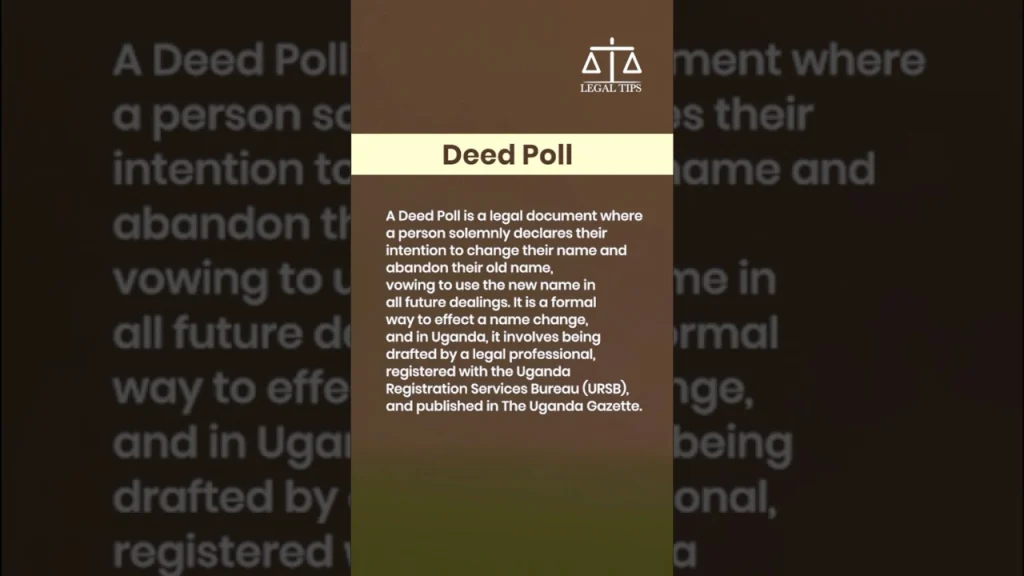
NIRA’s guidance distinguishes certain corrections requiring statutory declarations from changes involving a deed poll and Gazette requirements.
Do not assume that a document headed “affidavit of names” completes every name-related application.
First obtain the checklist for the precise change or explanation required.
How to Prepare the Correct Document
Step 1: Obtain the Actual Requirement
Ask the requesting organisation for its form or written checklist.
If its instructions use “affidavit” and “declaration” inconsistently, seek clarification before paying for preparation.
Step 2: Gather Supporting Records
Depending on the matter, useful records may include:
- Identification documents.
- Birth or marriage records.
- Academic documents.
- Relevant correspondence.
- Application references.
- Court documents.
Provide records supporting the facts you intend to state.
Step 3: Prepare a Clear Factual Account
Organise the information logically.
Use correct names, dates and reference numbers. Explain what you personally know and avoid filling gaps with assumptions.
For court affidavits, the applicable rules may impose particular requirements concerning knowledge, information and belief. Have the draft reviewed accordingly.
Step 4: Review Every Paragraph
Read the complete document before execution.
Check names, dates, addresses and attachments. Ask for an explanation of any wording you do not understand.
If you cannot read the language used, inform the professional before proceeding so the appropriate assistance and formalities can be arranged.
Step 5: Execute It Properly
Follow the authorised person’s instructions for signing and making the oath, affirmation or declaration.
Do not pre-sign and assume the professional can later certify that you appeared before them.
Step 6: Complete Registration or Filing
Where required, register the document with URSB or file it through the relevant court or administrative process.
Keep the executed document, receipt and acknowledgement securely.
What Should the Document Contain?
The required contents depend on its purpose, but check for:
- Correct identity of the maker.
- Relevant address or identifying particulars.
- Clear statements of fact.
- Appropriate document heading.
- Required attachments or exhibits.
- Correct execution date and place.
- Maker’s signature.
- Authorised person’s endorsement.
The Statutory Declarations Act prescribes its declaration form. Court documents should follow the applicable court requirements.
Changing the heading of an old template does not ensure compliance.
How Much Does It Cost?
Separate the possible charges:
| Cost component | What to confirm |
|---|---|
| Drafting | Professional preparation or advice |
| Execution | Applicable fee for taking the affidavit or declaration |
| Registration | URSB assessment where registration is required |
| Filing | Any relevant court or administrative charge |
| Additional services | Copies, translation or authentication |
The Statutory Declarations Act provides that the fee for making a declaration is the same as that for taking an affidavit.
That does not mean every complete application has the same total cost. Ask for an itemised explanation before proceeding.
Can You Make the Document Outside Uganda?
Yes, but the proper execution and acceptance requirements still matter.
For statutory declarations made abroad for use in Uganda, the Act recognises a person authorised under the law of the country where the declaration is made and includes the registration requirement described above.
For an affidavit intended for a Ugandan court, confirm the court-specific requirements before arranging execution overseas.
Also check whether authentication, identification or additional supporting evidence is needed for your particular use.
Common Mistakes to Avoid
Choosing by Convenience
Use the document required by the legal process, rather than whichever template is easiest to obtain.
Signing Without Understanding
You remain responsible for what the statement says.
Mixing Up Execution and Registration
A signature, stamp, registration acknowledgement and court filing each serve different functions.
Expecting Automatic Record Changes
Submit the document through the relevant correction or application process.
Making Unsupported Statements
Do not include facts you know to be false or recklessly present uncertain information as established.
False statutory declarations can attract criminal consequences. Affidavits also carry serious responsibilities.
Assuming Registration Guarantees Acceptance
The receiving authority may still examine the contents, supporting records and compliance with its requirements.
Frequently Asked Questions
Is a Statutory Declaration Weaker Than an Affidavit?
No. They serve different legal purposes. Both are formal statements carrying responsibilities.
Can a Commissioner for Oaths Take Both?
Yes, subject to the commissioner’s authority and applicable restrictions.
Can I Write the Draft Myself?
You can prepare the facts, but the document must follow the applicable form and execution requirements. Professional review is particularly useful for court proceedings or disputed facts.
Does URSB Registration Make the Statement True?
No. Registration does not relieve the maker of responsibility for accuracy or require another authority to accept the claim.
Can an Affidavit Replace a Statutory Declaration?
Do not assume they are interchangeable. Although the Act contains a provision treating certain affidavits as declarations, the appropriate document should be prepared for the intended process.
Does a Declaration Expire?
Check the applicable procedure and receiving organisation’s requirements. A statement may become outdated when circumstances change, and a recipient may require a recent document.
Choose the Document That Matches the Procedure
Start with the purpose and applicable requirement.
Use an affidavit where the court-related or statutory conditions apply, and a statutory declaration where the declaration procedure is appropriate. Then complete the required execution, registration and submission steps.
An accurately prepared statement is more useful than a document carrying the right-looking stamp but following the wrong process.
read Also; Procedure to Apply as an Independent Ice Supplier to the Fishing Industry in Uganda